If you've never booked a charter bus before, the first thing you discover is that "what comes on the bus" depends on a few decisions you haven't made yet. Vehicle class, fleet age, tier, operator, and trip type all change the answer. A 14-passenger Sprinter Van and a 56-passenger motorcoach are both "charter buses" in the colloquial sense, and they share almost no amenities in common.
Related planning: compare full-size charter bus rentals, read whether charter buses have bathrooms, check outlet availability, and review bus WiFi expectations.
This guide is the planner-grade reference that walks you through every amenity you can expect on a modern charter bus, broken out by vehicle class, tier, and trip type. We've built it as the single page you can read, bookmark, and reference when you're putting together a quote request for your wedding, corporate retreat, sports team, school field trip, church group, senior outing, or multi-day tour.
At Party Bus Chesapeake, we've been arranging group transportation since 2011 across thousands of trips and the full vehicle spectrum—14-passenger Sprinter Vans, 14-passenger Sprinter limos, 15- to 50-passenger party buses, 15- to 35-passenger minibuses, and 40- to 56-passenger charter buses. The comparison tables, persona sections, and quote-request checklist below all come from that operational experience. Use them, and you'll get a bus that matches the trip you're planning instead of one that surprises you on pickup day.
What is a Charter Bus, Exactly?
A charter bus is a private, hired-out passenger vehicle that operates on a custom itinerary set by the renting party, rather than on a fixed public route. You tell the operator where to pick up, where to drop off, and what stops to make in between, and the bus runs that schedule for your group only.
The terms "charter bus," "coach bus," and "motorcoach" are used essentially interchangeably in the United States. Technically, a "motorcoach" refers specifically to the larger, over-the-road style of bus with luggage bays underneath, raised passenger seating, panoramic windows, and onboard restrooms—the 40- to 56-passenger class. "Coach bus" is the same thing.
"Charter bus" is the broader umbrella term that includes motorcoaches plus minibuses, sprinter vans, party buses, and limos when they're rented for private group transportation.
A "school bus" is a different vehicle class entirely. In federal-safety terms, vehicles sold or leased for student transportation must meet school-bus FMVSS requirements; the yellow full-size buses planners picture are often Type C or Type D, though school-bus configurations also include smaller types. NHTSA notes that school-bus FMVSSs require stop arms and other school-bus-specific safety features.
They're built to a different federal safety standard and are not what most people mean when they say "charter bus." When school groups rent transportation, they typically rent motorcoaches or minibuses, not yellow school buses.
The main vehicle classes you'll encounter when shopping for charter transportation:
- Sprinter Van — 10 to 14 passengers. Built on a Mercedes-Benz Sprinter chassis. Compact, premium feel.
- Sprinter limo — 12 to 14 passengers. Sprinter chassis with stretched, party-bus-style interior: bar, LED lighting, sound system.
- Party bus — 15 to 50 passengers. Built around a celebration interior with bar, LED lighting, sound, and open dance area.
- Minibus — 15 to 35 passengers. Mid-size, often body-on-chassis builds from Glaval, Turtle Top, Champion, or ElDorado on Ford F-550 or Freightliner chassis. Standard rows of forward-facing reclining seats.
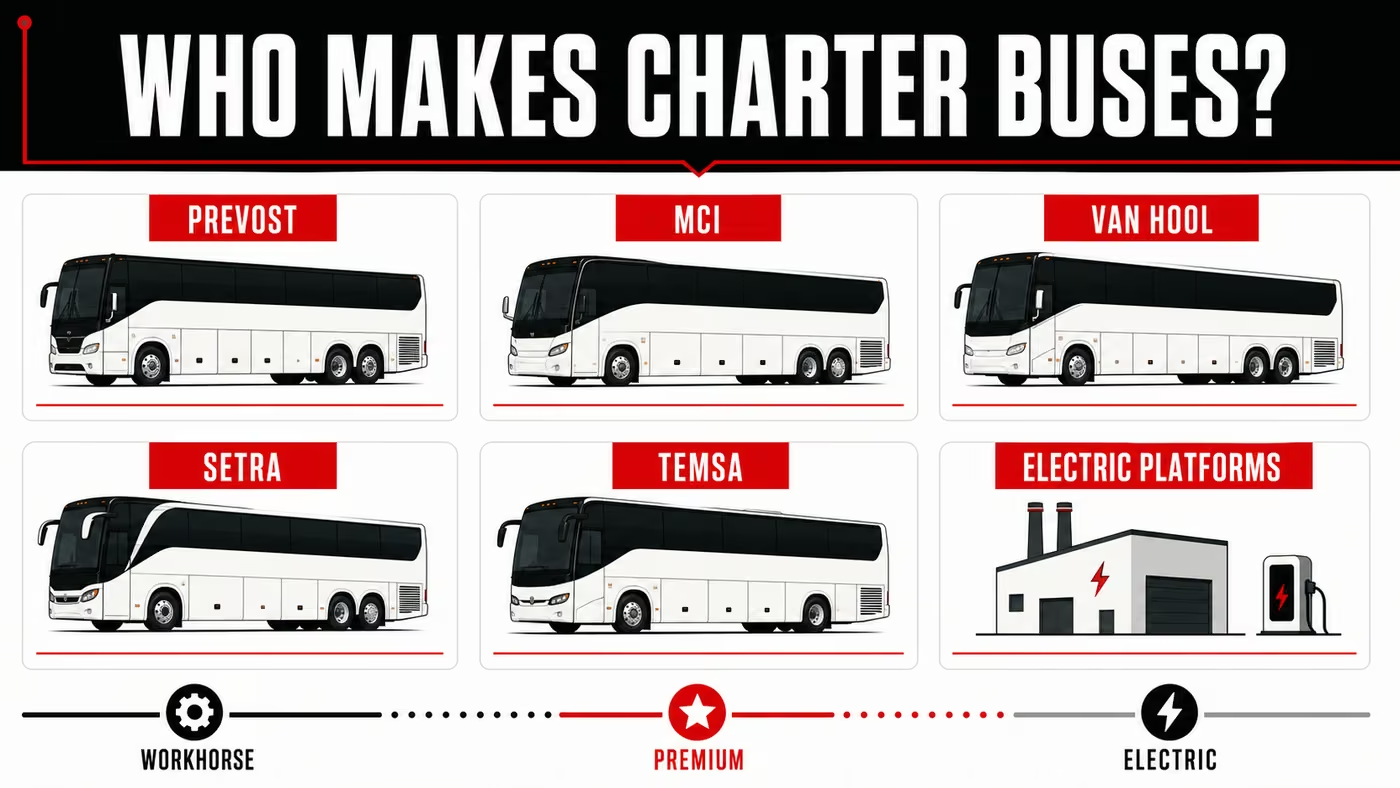
- Motorcoach / charter bus (full size) — 40 to 56 passengers. Over-the-road coaches from MCI, Prevost (part of Volvo Group), VDL Van Hool, Temsa, Setra, Irizar, and others. Restrooms, undercarriage luggage bays, WiFi, panoramic windows.
- Executive coach — typically 28 to 40 passengers in a high-end motorcoach shell with 2+1 leather seating, individual screens, work tables, and upgraded WiFi.
- Double-decker — 70 to 80+ passengers across two levels. Rare in the US charter market; more common as urban sightseeing tour buses.
What's Standard on a Modern Charter Bus
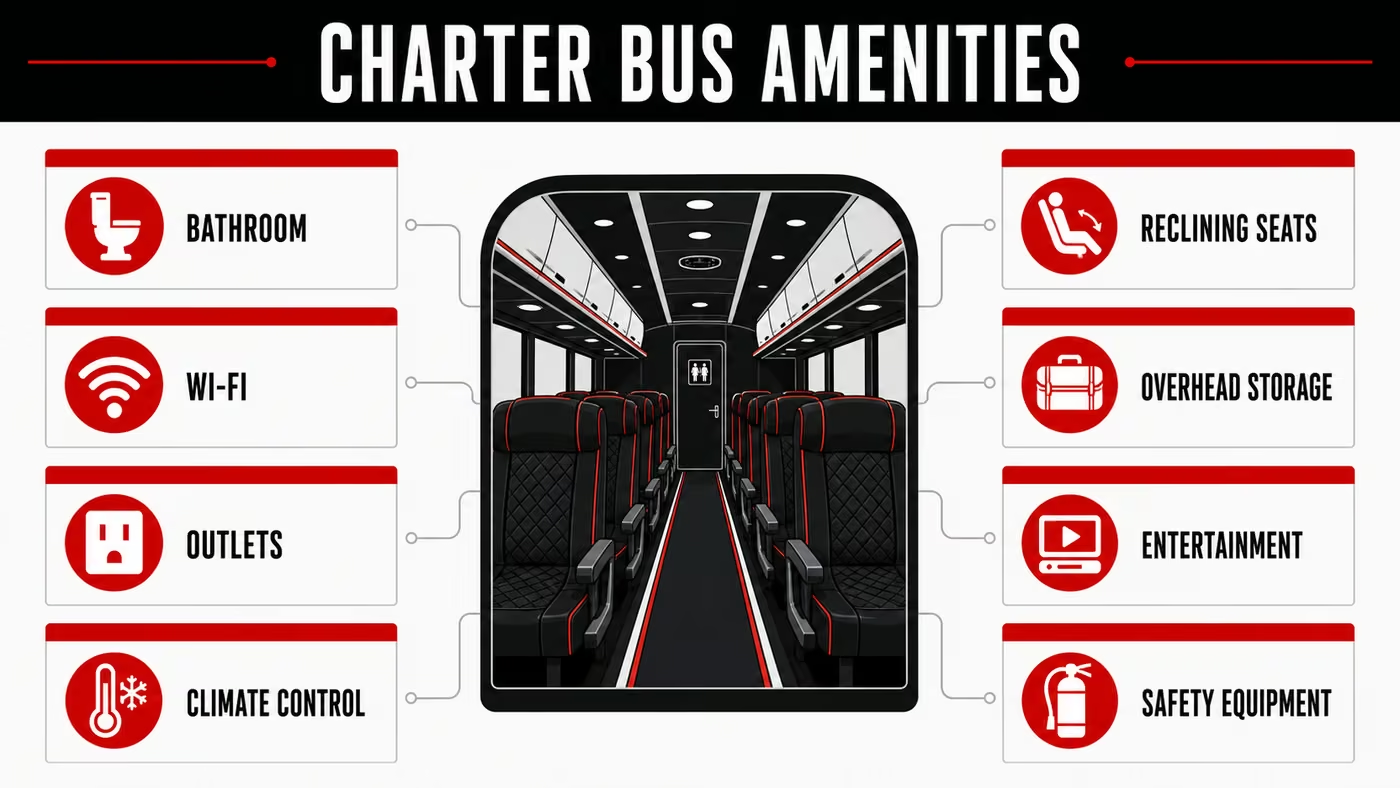
A modern, well-maintained 56-passenger motorcoach built in the last 10 years will come with a recognizable baseline of amenities. These are the features you should expect on a full-size charter bus without specifying or upgrading:
- Reclining seats with adjustable seatback recline (typically 3 to 4 inches of recline)
- Air conditioning and heat with both centralized and individual passenger air vents
- Overhead storage bins for personal items, jackets, and small bags
- Undercarriage luggage bays with combined capacity around 400 to 460 cubic feet on common 45-foot models, depending on configuration (MCI J4500: up to 445 cu ft; Prevost H3-45: 460 cu ft without wheelchair lift, 430 cu ft with lift)
- Reading lights at every seat
- PA system with a handheld or wireless microphone for the trip leader or tour guide
- Onboard restroom (typical, but not universal—always confirm)
- 110V AC power outlets and/or USB charging ports (common on newer fleets, but still a confirm-at-quote item)
- WiFi (cellular-backed; common on newer fleets but not universal—see the dedicated section below and confirm it on the dispatched vehicle)
- Panoramic tinted windows
That's the baseline for a 56-passenger motorcoach. As you move down in vehicle class, several of those features either disappear or change form. A minibus will typically not have an onboard restroom, undercarriage luggage bays, or a PA system.
A Sprinter Van will not have any of those, but will offer a more premium feel through leather seats, tinted privacy windows, and individual climate control. A party bus replaces the seated-rows layout entirely with perimeter wraparound seating, a built-in bar, LED color-changing lighting, and a premium sound system, and it typically has no onboard restroom.
Charter Bus Amenities by Vehicle Class (Comparison Table)
Here is the comparison table that nobody else has built. Use it to identify which vehicle class fits the amenities your trip actually needs.
| Amenity | Sprinter Van (10-14) | Sprinter Limo (12-14) | Minibus (15-35) | Party Bus (15-50) | Motorcoach (40-56) | Executive Coach (28-40) |
|---|---|---|---|---|---|---|
| Passenger capacity | 10-14 | 12-14 | 15-35 | 15-50 | 40-56 | 28-40 |
| Onboard restroom | No | No | Rare | Rare | Yes, standard | Yes, standard |
| WiFi | Available on request | Available on request | Available on request | Available on request | Common on newer fleets; confirm | Typically upgraded; confirm |
| 110V outlets | Rare | Available | Available on newer fleets | At bar area | Yes, typically at every row | Yes, every seat |
| USB ports | Available | Available | Available on newer fleets | Available | USB-A common; USB-C on newer/options | USB-A/USB-C often available; confirm |
| Reclining seats | Yes, premium leather | Wraparound, not reclining | Yes | Wraparound, not reclining | Yes, 3-4 inches | Yes, extended recline, often 2+1 layout |
| Climate control | Individual vents | Cabin AC | Centralized plus vents | Centralized | Centralized plus individual vents | Centralized plus individual vents |
| Overhead storage | Limited | No | Yes | Limited | Yes, full overhead bins | Yes, full overhead bins |
| Undercarriage luggage bays | No | No | Limited or none | No | Yes, roughly 400-460 cu ft on common 45-foot models | Yes, roughly 400-460 cu ft on common 45-foot models |
| TVs / DVD / streaming | Rare | Yes, flatscreens | Available on newer fleets | Yes, multiple flatscreens | Yes, standard | Yes, individual seat-back screens on top tier |
| PA system / mic | No | Available | Available | Available | Yes, standard | Yes, standard |
| Seat belts | Lap-and-shoulder in factory passenger layouts | Varies by conversion; confirm | Varies by GVWR/build; confirm | Varies by conversion/perimeter seating; confirm | Lap-and-shoulder on covered post-2016/2017 builds | Lap-and-shoulder on covered newer builds |
| Wheelchair lift availability | Available on request | No | Available on request | Rare | Available on request under ADA/DOT rules | Available on request |
| Built-in bar / LED lighting | No | Yes | No | Yes | No | No |
| Premium sound system | Standard audio | Yes | Standard audio | Yes, club-grade | Standard audio | Premium |
A quick reading guide: full-size motorcoaches and executive coaches anchor the high end of the amenity spectrum, especially for longer trips where restrooms, undercarriage storage, and serious WiFi matter. Sprinter Vans and Sprinter limos offer the most premium feel per passenger but lose the restroom and luggage bay. Party buses optimize for celebration, not utility, and lose the restroom and undercarriage storage.
Minibuses are the versatile middle that work for a wide range of trips when full-size capacity isn't needed.
The Four Most-Asked Amenity Questions, Answered
Do Charter Buses Have Bathrooms?
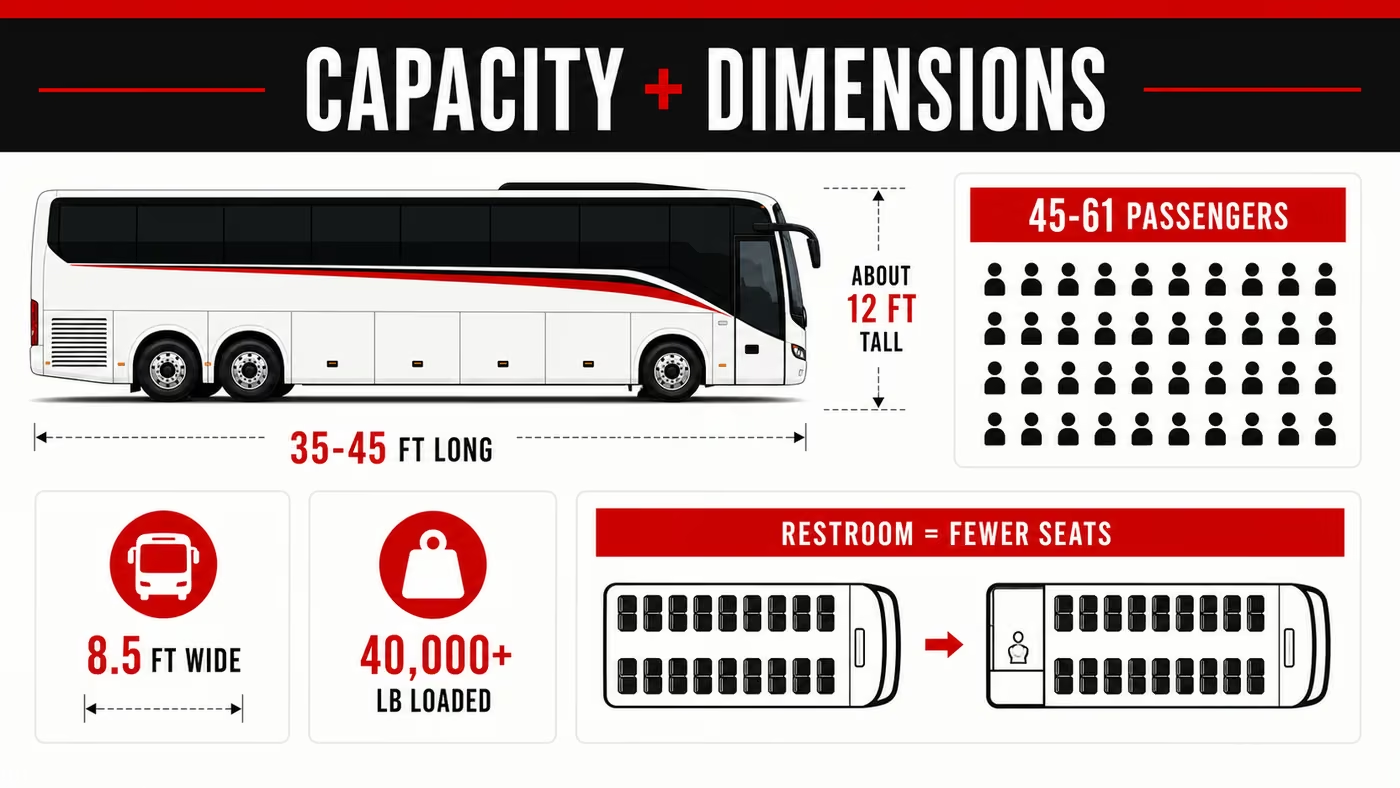
Yes—most full-size motorcoaches (40 to 56 passengers) come with an onboard restroom as standard equipment. The restroom is typically located at the rear of the bus, in a small enclosed cabin roughly 36 by 48 inches. It has a hand-sanitizer station (most modern fleets installed these post-2020), a small sink in many cases, and a chemical or recirculating-water toilet system.
Smaller vehicle classes—minibuses (15 to 35 passengers), party buses, Sprinter Vans, and Sprinter limos—typically do not have onboard restrooms. Trip planners booking these classes should build planned restroom stops into the itinerary roughly every 90 to 120 minutes for passenger comfort.
A few etiquette notes for onboard restrooms: many operators ask passengers to reserve the onboard restroom for light use and use planned rest stops for heavier use, with signage indicating the preferred policy on that specific bus. Long-distance multi-day tours sometimes book newer fleets with upgraded waste systems that support more flexible use. If your trip is going to be long enough that restroom flexibility matters, ask the operator directly about the system on the specific bus they'll dispatch.
Do Charter Buses Have WiFi?
Yes, many modern full-size motorcoaches offer onboard WiFi, but it is not universal or guaranteed unless the operator confirms it for the dispatched bus. Operators commonly treat WiFi, power outlets, TV, and bathrooms as special-request amenities that depend on the vehicle. The honest version, though, requires a caveat: charter bus WiFi is cellular-backed.
It's a 4G or 5G mobile hotspot powering a router that 30 to 50 people share simultaneously. It is not enterprise-grade fiber internet.
What you can reasonably expect on charter bus WiFi:
- Browsing, email, and social media for the whole bus, at reasonable speeds
- Light streaming (music, low-resolution video) for a handful of passengers at once
- Spotty performance in rural areas, in tunnels, and in mountainous terrain where cellular coverage drops
What you should not expect:
- Smooth high-definition video streaming for 30+ passengers simultaneously
- Reliable video conferencing for client-facing calls (the latency and packet loss of mobile hotspots aren't built for it)
- Continuous connectivity through dead zones—a 20-minute stretch of I-80 through Wyoming or a tunnel under the Chesapeake Bay can drop the signal entirely
If WiFi is mission-critical for your trip—say, your corporate team genuinely needs to work for 4 hours en route to a conference—ask the operator at quote time whether the bus carries a dual-carrier or multi-carrier router (which can use more than one cellular carrier for redundancy), and whether the route passes through known dead zones. Some premium and executive coaches offer significantly upgraded WiFi setups; standard motorcoach WiFi is best treated as adequate-for-light-use rather than business-grade.
Do Charter Buses Have Outlets and Charging Ports?
Yes—many modern motorcoaches have 110V AC power outlets and/or USB charging ports at every row, or at every individual seat on newer and executive-tier coaches. Fleet age matters more here than any other amenity. A 2010-model-year motorcoach might have one or two 110V outlets toward the front and back.
A newer-model motorcoach may have USB charging at individual seats, with 110V outlets shared per row.
USB-A is still common across US charter fleets, while USB-C is increasingly available on newer or upgraded coaches. If your group is bringing newer phones, laptops, or tablets that need USB-C, bring your own cables and adapters, or specifically ask the operator if the dispatched bus has USB-C charging. For example, MCI lists USB-A and USB-C port options at each passenger seat on its J3500/J4500 platform, but "available" still means you should confirm the specific bus.
Charging is rarely a problem on charter buses for typical-use trips. It becomes a problem when groups assume continuous power for laptops on long itineraries and find the outlet sharing inconvenient. If power is critical, ask at quote time.
Premium and Luxury Charter Bus Amenities
The amenity spectrum doesn't stop at the standard 56-passenger motorcoach. There's a clear tier hierarchy that runs Standard → Premium → Executive → Luxury, with each tier adding meaningful upgrades to seating, technology, and onboard environment.
| Feature | Standard | Premium | Executive | Luxury |
|---|---|---|---|---|
| Seating layout | 2+2 rows, 56-passenger | 2+2 rows, 47-passenger with more legroom | 2+1 captain's chairs, 28-36 passenger | 1+1 lounge, 20-28 passenger |
| Upholstery | Cloth fabric | Higher-grade cloth or vinyl | Leather | Premium leather, custom stitching |
| Recline | 3 inches | 4 inches | Extended recline, footrests | Lie-flat or near-lie-flat on sleeper-tier vehicles |
| Screens | 3-4 overhead flatscreens | 4-6 overhead flatscreens | Individual seat-back screens | Large individual screens with streaming |
| WiFi | Single-carrier cellular | Single-carrier cellular | Dual-carrier router | Premium multi-carrier or satellite-backed on select services |
| Outlets per seat | Shared per row | 110V + USB-A per row | 110V + USB-A + USB-C at every seat | Same, with wireless charging on some vehicles |
| Work tables | Seat-back tray only | Seat-back tray | Folding work tables | Full conference tables |
| Typical use cases | School trips, sports teams, fan travel | Corporate retreats, weddings, multi-day tours | Client-facing corporate travel, premium tours | Long-haul luxury, executive entertainer travel |
Almost all of Party Bus Chesapeake's fleet operates at the Standard and Premium tiers, which fit the vast majority of group transportation needs at the most practical pricing. Executive coaches are available on request for client-facing corporate travel where the bus itself is part of the company's impression on a client.
What Changes by Trip Type: Planner Persona Sections
Different trips prioritize different amenities. Here's the breakdown by the most common group transportation scenarios.
Weddings
Wedding shuttles are short, dense, and formal. Most wedding trips are 30 minutes to 2 hours each way, run on tight scheduling between hotel block, ceremony, reception, and return, and carry guests in formalwear who don't want to wrinkle dresses or suits on a cross-country marathon.
Amenities that matter for weddings:
- Reliable climate control — summer outdoor venues turn buses into greenhouses; A/C performance is non-negotiable
- Interior cleanliness and exterior presentation — the bus shows up in wedding photos
- Onboard restroom — matters less than for longer trips, but appreciated when ceremony and reception are far apart
- Adequate luggage storage — for the bridal party's overnight bags and the wedding gear that always seems to materialize day-of
Vehicle picks: A 14-passenger Sprinter limo is the right photo-ready pick for the bridal party itself on the wedding day. For guest shuttles between the hotel block and the venue, a 25- to 35-passenger minibus or a 47- to 56-passenger motorcoach handles guest volume cleanly. For the bachelorette or bachelor night out, 15- to 50-passenger party buses with built-in bar, LED lighting, and premium sound make the ride part of the celebration.
See our full wedding transportation services for more.
Corporate Events
Corporate group transportation runs from short executive transfers to multi-day retreat logistics. The amenities that matter shift dramatically based on whether the bus is client-facing or internal.
For client-facing trips (transporting prospects, customers, or executives where the bus contributes to the company's impression):
- Executive-tier upgrade — leather 2+1 seating, individual screens, work tables, premium WiFi
- 14-passenger Sprinter Van for small VIP groups
- Quiet cabin and professional driver presentation
For internal team transportation (shuttling employees to off-sites, conferences, or team-building):
- WiFi reality check — set expectations that it's adequate-for-light-use, not enterprise-grade
- Outlets at every seat for laptop work during the ride
- PA system if the bus is being used as a mobile briefing space
- Standard motorcoach at 47 or 56 passengers handles most internal trips well
See our corporate event transportation services for more on configuring corporate trips.
Sports Teams
Sports team transportation prioritizes equipment storage, athlete comfort on long rides, and meal-friendly interiors.
- Undercarriage luggage bays — non-negotiable for equipment hauling. Common 45-foot motorcoach models list underfloor luggage capacity around 400 to 460 cubic feet—MCI lists up to 445 cubic feet on the J4500, and Prevost lists 460 cubic feet on the H3-45 without a wheelchair lift—which typically holds a high-school football team's gear bags and helmets.
- Seat pitch — taller athletes need more legroom; a 47-passenger motorcoach with extra row spacing beats a cramped 56-passenger.
- Onboard restroom — mandatory for 4- to 8-hour rides to away games and tournaments
- WiFi and outlets — for film study and homework time on the road
- Climate control — teams sweating in uniform need real A/C, not nominal
For fan travel rather than team travel, the priorities shift toward celebration. Party buses with built-in bars work for adult fan groups; motorcoaches with PA systems work for organized booster trips. See our sporting event transportation services.
School Field Trips
School trips have a distinct amenity priority set driven by safety, supervision, and budget.
- Lap-and-shoulder seat belts — especially for younger students; ask for post-2016 fleet
- A/V system for educational programming — flatscreens with DVD or streaming for documentaries or movies on long rides
- Chaperone sight lines — an aisle that lets adults see and reach kids quickly
- Restroom for elementary-age trips — younger students can't reliably hold for the standard 2-hour stretch between rest stops
- Cost-effective tier — Standard motorcoach is almost always the right fit; Executive is overkill for school budgets
Church and Youth Groups
Church and youth group transportation overlaps significantly with the school trip profile, with two main differences: trips are often longer (weekend retreats, mission trips), and the amenity priorities tilt toward overnight luggage storage and group cohesion.
- Undercarriage luggage bays for overnight bags, retreat materials, and ministry supplies
- PA system for group leaders to address the bus
- Onboard restroom for longer trips
- Standard or Premium tier motorcoach — appropriate balance of cost and comfort
Senior Groups
Senior group transportation deserves a focused amenity priority list:
- Low-step or kneeling entry for passengers with limited mobility
- Wheelchair lift — available on request from operators; specify at quote time
- ADA-accessible restroom — less common than the lift; confirm specifically
- Overhead grab handles in the aisle for stability during boarding
- Reclining seats with extended recline for passenger comfort on long trips
- Reliable climate control — older passengers are more sensitive to temperature swings
- PA system for tour-guide narration on sightseeing trips
The standard recommendation for senior group trips is a full-size motorcoach with the accessibility package specified at quote time.
Multi-Day Tours
Multi-day tour transportation involves the most demanding amenity stack of any persona, because the bus becomes a living space for hours per day across multiple days.
- Premium or Executive tier worth the upgrade — leather seats, extended recline, individual screens
- Onboard restroom with newer-generation waste system
- PA system for tour-guide narration
- WiFi with realistic expectations — great for evening downtime in hotels, spottier in transit
- Undercarriage luggage bays sized for multi-day luggage
- Driver-swap policy understanding — federal passenger-carrier hours-of-service rules generally limit drivers to 10 hours of driving after 8 consecutive hours off duty and 15 hours on duty before another 8-hour off-duty break; FMCSA summarizes those passenger-carrier limits here, and multi-day tours often require driver swaps
How to Specify Amenities When You Request a Quote: The Planner Checklist
Here's the 15-item checklist to use when you request a quote from any charter bus operator. The more specific you are about your amenity needs, the better the operator can match a vehicle to your trip and the fewer surprises happen on pickup day.
- Passenger count — with a buffer of 10 to 15% for last-minute additions
- Total trip length — in hours and approximate miles
- Onboard restroom needed? Yes or no
- WiFi expected? If so, what for (light browsing vs. work)
- Power outlets at every seat? Or shared per row is fine?
- USB-A or USB-C charging?
- Reclining seats?
- A/V needs — TVs, streaming, DVD, PA microphone
- Storage volume needed — estimate in carry-on equivalents per person, plus any equipment
- Accessibility needs — wheelchair lift, accessible restroom, low-step entry, service animals
- Seat belts — specify lap-and-shoulder if needed for the group
- Vehicle tier preference — Standard, Premium, Executive, or Luxury
- Fleet age preference — newer fleets carry more current amenities
- Driver-swap policy on long trips — for itineraries that approach 10 driving hours or 15 on-duty hours in a duty period
- Pickup and drop-off logistics that affect vehicle class — tight urban turns and narrow venue driveways may require a minibus instead of a full-size motorcoach
Paste this directly into your quote request email or use it as a phone-call checklist when you call our reservations team. The more boxes checked, the closer the bus that shows up matches the trip you're planning.
Frequently Asked Questions About Charter Bus Amenities
How many passengers fit on a charter bus?
Standard charter bus passenger capacities run from 10 (Sprinter Van) to 56 (full-size motorcoach). The most common configurations are 47-passenger motorcoaches (with extra legroom) and 56-passenger motorcoaches (maximum capacity at standard seat pitch). Minibuses cover the 15-to-35-passenger range; party buses span 15 to 50 passengers in a celebration-style interior.
How big are charter bus luggage compartments?
Full-size motorcoach undercarriage luggage bays typically hold roughly 400 to 460 cubic feet of luggage on common 45-foot models, with capacity reduced on some wheelchair-lift configurations; MCI lists 445 cubic feet on the J4500 and 430 cubic feet with a rear lift, while Prevost lists 460 cubic feet on the H3-45 without a wheelchair lift and 430 cubic feet with one. As a working rule, that's roughly one checked suitcase plus one carry-on per passenger for a 56-passenger bus. Equipment-heavy groups (sports teams, bands, mission groups with supplies) often max out luggage bays before they max out seating.
How much legroom is on a charter bus?
Standard 56-passenger motorcoach seat pitch (the distance from one seat-back to the seat-back behind it) is typically 30 to 32 inches. A 47-passenger configuration trades 9 seats for additional legroom, running 34 to 36 inches of pitch. Executive coaches with 2+1 leather seating often offer 38+ inches with extended recline and footrests.
Do charter buses have TV screens?
Most full-size motorcoaches have between 3 and 6 overhead flat-screen monitors distributed throughout the cabin, with DVD player and increasingly HDMI input for streaming media. Executive-tier coaches offer individual seat-back screens. Sprinter Vans and minibuses typically don't have TV screens as standard equipment.
Can I bring food and drinks on a charter bus?
Most operators allow non-alcoholic food and drinks onboard. Alcohol policies vary by operator, by state law, and by vehicle class—party buses and Sprinter limos are designed for alcohol consumption and have built-in bars, while standard motorcoaches typically allow no open containers. Always confirm at quote time.
Do charter buses have sleeping accommodations?
Standard motorcoaches do not have dedicated sleeping berths. Reclining seats with footrests offer comfortable enough rest for overnight rides, but they are not flat. Premium sleeper-style products may advertise private suites, deeply reclining seats, or other long-haul upgrades, but those are not standard charter bus amenities.
Entertainer coaches built on Prevost H3-45 shells by converters like Liberty Coach and Featherlite are the exception; they include multiple bunks, but those are not standard charter rental vehicles.
Are charter bus amenities the same across the US?
Largely yes, with two caveats. First, fleet age varies dramatically by operator and region; a 10-year-old motorcoach in a small market may have fewer USB-C ports and older WiFi hardware than a 2-year-old coach in a major market. Second, operators in different regions may dispatch slightly different model preferences—some fleets are MCI-heavy, some are Prevost-heavy, some run Van Hool.
The core amenities are consistent; the brand and model details vary.
Booking the Right Bus for Your Trip
The right charter bus for your group depends entirely on what your trip actually needs—not on a generic "best bus" answer. A 30-mile wedding shuttle and a 700-mile multi-day sports team trip use different vehicles, in different tiers, with different amenity priorities. The comparison tables and checklist above are built to get you to the right answer.
Party Bus Chesapeake has been arranging group transportation since 2011, with access to a fleet that spans every vehicle class in this guide—14-passenger Sprinter Vans and Sprinter limos, 15- to 50-passenger party buses, 15- to 35-passenger minibuses, and 40- to 56-passenger motorcoaches. Our 24/7/365 reservations team helps planners walk through the checklist on every call, so the bus that arrives on pickup day matches the trip you actually planned.
Call us anytime at 757-755-8162, or use our online quote tool to see live pricing and vehicle availability for your trip in under 30 seconds. Bring the checklist; we'll do the rest.