Buses, as we know them, were invented in 1662—when French mathematician Blaise Pascal launched the world's first scheduled public transit service on the streets of Paris. His "carrosses à cinq sols" carried passengers along five fixed routes for five sols per ride, predating the motorized vehicle by more than two centuries and establishing an idea that would reshape cities, schools, and entire continents.
For practical next steps after the history, compare our types of buses guide, charter bus manufacturers guide, and 40-56 passenger charter bus rental page.
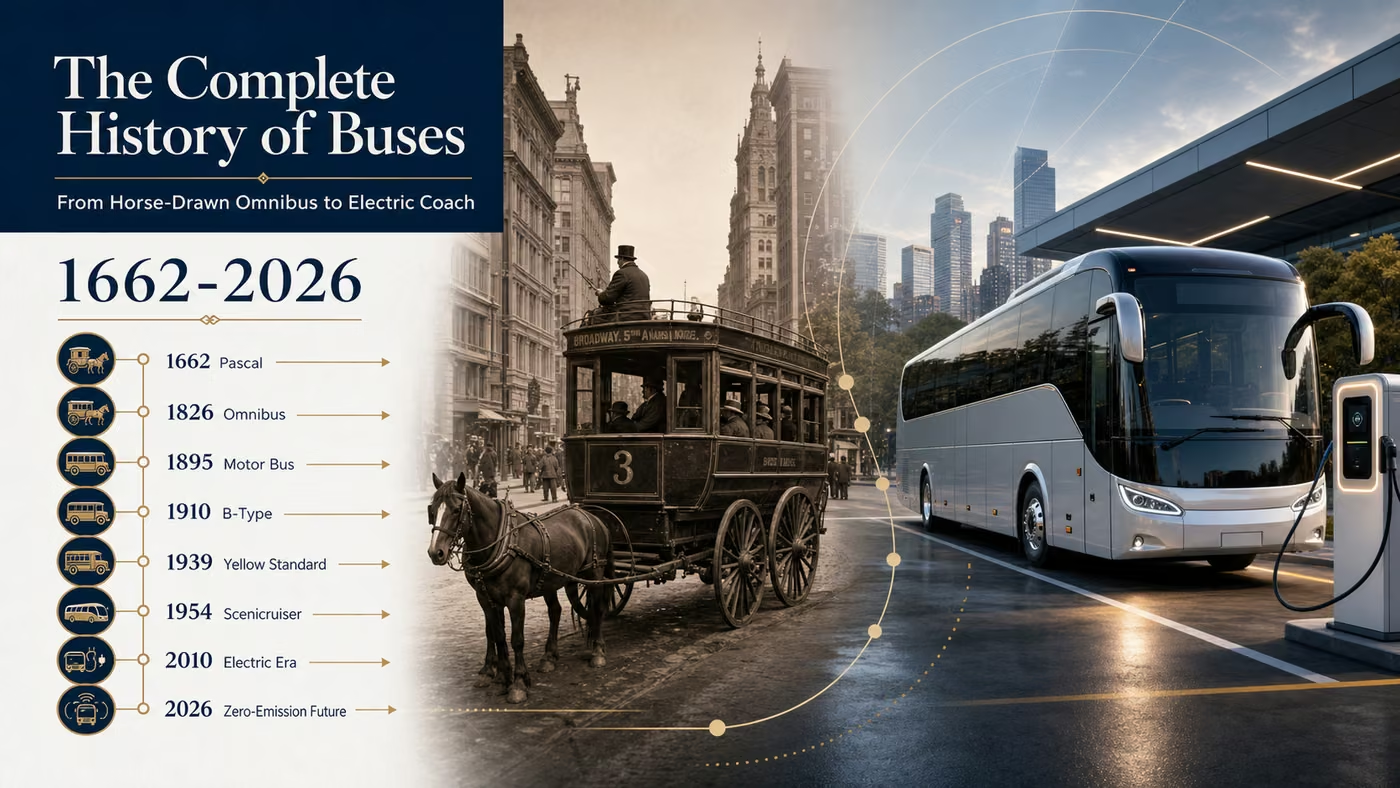
From Pascal's 1662 experiment to today's battery-electric coaches charging in Los Angeles bus depots, the bus has been continuously reinvented for more than 360 years. This guide walks through the full chronology—the omnibus era, the steam buses that failed under British road tolls, Carl Benz's 1895 motor bus, the 1910 London B-type that carried Tommies to the Western Front, Wayne Works' 1892 "School Car" that became a key ancestor of the modern school bus, Greyhound's Hibbing-to-Alice origins, the Volkswagen Type 2 counterculture icon, and the electric, hydrogen, and autonomous coaches reshaping the industry right now.
It is also a practical reference—answering the most-asked questions about bus history (who invented the bus, when school buses first appeared, why they are painted yellow, how Greyhound began) in a single, dated, sourceable place. Whether you are researching a school project, satisfying enthusiast curiosity, or simply Googled "when were buses invented," this is the most comprehensive history of buses you will find on the open web.
Party Bus Chesapeake has spent more than 15 years operating coaches that descend directly from this lineage—MCI and Prevost motorcoaches whose corporate ancestors stretch back to the 1920s and '30s. We wrote this guide because the history of our industry deserves to be told well.
Before the Bus: The Pre-History of Scheduled Transit
Before 1662, urban transportation in Europe meant hired hackney carriages, sedan chairs, river ferries, and your own two feet. The wealthy traveled in private coaches; everyone else walked. There was no such thing as scheduled, fixed-route public transit—the idea simply had not been invented yet.
That changed in Paris on March 18, 1662, when Blaise Pascal—the same mathematician famous for Pascal's Triangle and foundational work in probability theory—launched a service of horse-drawn carriages running fixed routes at fixed times for a fixed fare of five sols. The vehicles were called carrosses à cinq sols, literally "five-sol carriages". Five routes crisscrossed Paris, with the first running between the Porte Saint-Antoine and the Luxembourg Palace.
The system worked. Briefly. Pascal had secured royal backing from King Louis XIV, and on launch day, large crowds turned out to ride.
But there was a catch: the service was restricted to nobility and bourgeois passengers. Soldiers, "lackeys," and laborers were forbidden from boarding. As novelty wore off and the elite returned to their private carriages, ridership collapsed.
The service declined after restrictions and fare increases and appears to have disappeared by the mid-1670s, often dated 1675 or 1677.
Pascal himself died just months after the launch, in August 1662, never seeing what his idea would eventually become. But the concept—scheduled, fixed-route, fixed-fare urban transit—was now loose in the world. It would take another 164 years before someone got it to stick.
The Omnibus Era: Transit "For All" (1820s–1880s)
The man who finally made public transit work was not an inventor or engineer. He was a retired French army officer named Stanislas Baudry, and by the mid-1820s he was running a flour mill and public baths on the outskirts of Nantes, France.
Baudry's baths were heated by waste steam from his flour mill. To draw customers from the city center to his out-of-town spa, he started a free horse-drawn shuttle service. Passengers, it turned out, were much more interested in the shuttle than in the baths—they used it to get to other destinations along the route, hopping on and off as they pleased.
Baudry, no fool, recognized the real business opportunity. He started charging fares.
In 1826, Baudry's Nantes shuttle became the durable modern omnibus model. The legend, repeated for nearly two centuries, holds that one of his shuttle stops was located in front of a hatter's shop owned by a Monsieur Omnès, whose sign read "Omnes Omnibus"—a Latin pun meaning "Omnès for all." Whether or not the hatter story is strictly accurate (modern historians treat it with some skepticism), the word stuck. Baudry called his service voitures omnibus—"vehicles for all"—and within years, "omnibus" became the universal name for horse-drawn urban transit.
The English language eventually shortened it to one syllable: bus.
Baudry expanded to Paris in 1828 and the model spread quickly:
- London, 1829: George Shillibeer, a British coachbuilder who had spent time in Paris, launched London's first omnibus service on July 4, running between Paddington and the Bank of England. Shillibeer's omnibuses seated 22 passengers and were pulled by three horses abreast.
- New York, 1827: Abraham Brower introduced the first American omnibus, a converted stagecoach running along Broadway. By the 1830s, omnibus lines crisscrossed Manhattan.
- Across Europe: Berlin, Vienna, Madrid, and other capitals adopted the omnibus within a generation.
The horse-drawn omnibus dominated urban transit for roughly 60 years. At its peak, London alone had thousands of omnibuses carrying tens of millions of passenger trips per year. The vehicles were uncomfortable, slow, and cripplingly inefficient—a single omnibus required a team of horses that had to be rotated multiple times per day, and the manure crisis they generated became a notorious 19th-century urban health problem.
But for the first time in human history, cities had genuine mass transit. The bus, as a social and economic institution, had arrived.
Steam, Electricity, and the Dawn of the Motor Bus (1830s–1900)
Inventors began trying to mechanize the omnibus almost as soon as it existed. The first serious attempt came in 1833, when British engineer Walter Hancock ran a steam-powered bus called Enterprise between London and Paddington. Hancock followed with several successors—Autopsy, Era, Automaton—all running scheduled services in and around London during the 1830s.
Hancock's steam buses worked. They were faster than horses and could carry more passengers. But they ran afoul of regulators and entrenched interests almost immediately.
British turnpike trusts imposed punitive tolls on steam vehicles. The Locomotive Acts of 1861 and 1865 (the latter famously known as the "Red Flag Act") imposed speed limits as low as 2 mph in towns and required a person to walk ahead of every self-propelled vehicle waving a red flag. Combined with a series of well-publicized boiler explosions, the steam bus was effectively legislated off British roads.
Hancock had been right; the political environment was wrong.
Electric traction came next. Werner von Siemens demonstrated the first electric trolleybus—the Elektromote—in Halensee, Berlin, in 1882. Drawing current from overhead wires, trolleybuses spread to dozens of cities through the late 19th and early 20th centuries.
They were quieter, cleaner, and more efficient than horse-drawn omnibuses, but they were tethered to overhead infrastructure—not true free-roaming buses.
The breakthrough came in 1895. In the German region of Siegerland, the Netphener Omnibus-Gesellschaft launched the world's first scheduled motor bus service using Benz Omnibus vehicles built by Carl Benz—the same engineer who had patented the Benz Patent-Motorwagen automobile in 1886. The Netphener route ran 15 kilometers between Siegen, Netphen, and Deuz, carrying eight passengers at a time.
The service launched on March 18, 1895—233 years to the day after Pascal's first omnibus rolled in Paris, an almost too-perfect coincidence. The Netphener buses suffered from the same problems that plagued early automobiles: the roads were terrible, the engines unreliable, and the horses-versus-cars political fight was just beginning. The service folded within months.
But the demonstration was made. The age of the motor bus had begun.
The Motor Bus Revolution and the B-Type (1900–1930)
The first decade of the 20th century saw motor buses compete head-to-head with horse-drawn omnibuses and electric trams in city after city. The motor bus won decisively for one reason: it scaled. A horse-drawn omnibus required a stable of horses, hay, oats, blacksmiths, and a small army of grooms.
A motor bus required gasoline and a mechanic.
The decisive vehicle was the London General Omnibus Company B-type, introduced in 1910. The B-type is widely regarded as the world's first reliable, mass-produced motor bus. Powered by a 30 hp Daimler engine and seating 34 passengers (16 inside, 18 on the open-top upper deck), the B-type was rugged, reliable, and built in quantity.
The London General Omnibus Company had replaced its horse buses by 1911–1912; the last recorded horse omnibus in London, operated by Tilling, ran on August 4, 1914.
Then came the First World War. The British War Office requisitioned more than 900 B-type buses, painted them khaki (though many retained their original London Bovril and Pears' soap advertising under the paint, visible to confused troops at the front), and shipped them to France and Belgium. The B-types carried British troops to the trenches at the First Battle of Ypres in 1914 and shuttled wounded soldiers back behind the lines.
The most famous survivor was B43, later named "Ole Bill," an AEC B-type built in 1911, bought by the War Office in 1914, and used in France and Belgium; it is preserved by the Imperial War Museums; London Transport Museum's B2737 is a separate restored 1914 B-type "Battle Bus" in its own right.
The 1920s saw motor bus services explode across the United States. Three founding events stand out:
- Greyhound, 1914: A Swedish immigrant named Carl Eric Wickman, working in Hibbing, Minnesota, started carrying miners between Hibbing and nearby Alice in a seven-passenger car. He charged 15 cents per ride. The operation grew into regional bus companies that eventually became Greyhound Lines—a name reportedly inspired by a sleek gray bus that a hotel owner said looked "like a greyhound" streaking down the road.
- Prevost, 1924: A Quebec cabinetmaker named Eugène Prevost built a wooden bus body on a truck chassis in Sainte-Claire, Québec. The company that grew from that single bus is today one of the two dominant North American motorcoach manufacturers.
- Motor Coach Industries (MCI), 1933: A Winnipeg entrepreneur named Harry Zoltok founded Fort Garry Motor Body and Paint Works, which was renamed Motor Coach Industries in 1941. MCI would go on to become the largest motorcoach manufacturer in North America.
By 1930, intercity bus networks linked virtually every American city of any size. The economic logic was undeniable: a Greyhound ticket cost a fraction of a train fare and reached towns the railroads never had. For working-class Americans in the Depression years that followed, the bus was the only affordable way to travel any meaningful distance.
The School Bus: From "School Car" to Yellow Standard (1892–1939)
The American school bus has its own distinct lineage—one that runs parallel to the urban omnibus and intercity coach traditions and ends with a one-week conference at Teachers College, Columbia University, in New York City, that produced the most recognizable color scheme in transportation history.
The better-supported origin point is 1892, when Wayne Works of Indiana built a horse-drawn "School Car" for an Ohio school district. The vehicle had bench seating along the sides and a rear entrance, and it became the best-documented ancestor of the dedicated American school bus.
The horse-drawn school-transport era lasted roughly 40 years. The transition to motorized school buses began in earnest in the 1910s and accelerated dramatically in the 1920s as more states consolidated rural one-room schoolhouses into larger central schools, increasing the average distance students traveled.
In 1925, a Ford dealer named Albert L. Luce Sr. in Fort Valley, Georgia, mounted a purchased wood body on a Ford truck frame.
After that body failed on Georgia roads, he reinforced the design with steel and turned the idea into Blue Bird—today one of the "big three" American school bus manufacturers alongside Thomas Built Buses and IC Bus. A 1927 Blue Bird is preserved at the Henry Ford Museum in Dearborn, Michigan, and is generally regarded as the oldest surviving purpose-built school bus in America.
By the late 1930s, school buses were everywhere—but they were chaos. Every state, every county, every manufacturer used different specifications. Bodies were different sizes.
Seats faced different directions. Doors opened on different sides. Colors ranged from red to green to white to whatever paint the local school district had on hand.
There were no safety standards. There were no construction standards. The vehicles were lethal.
The fix came from a Columbia University education professor named Frank W. Cyr. In April 1939, Cyr convened a seven-day conference at Teachers College, Columbia University, in New York City, bringing together state school transportation officials from all 48 states, plus engineers from every major school bus manufacturer and representatives from paint companies.
Their charge: produce a unified national standard for school buses.
They produced 44 standards—covering body dimensions, seat construction, aisle width, ceiling height, window glazing, emergency exits, and dozens of other details. And they chose a color.
The conference selected "National School Bus Chrome", the color now generally referred to as National School Bus Glossy Yellow or national school bus yellow, because:
- The hue is highly visible at dawn and dusk, when school buses operate most.
- Black lettering ("SCHOOL BUS") contrasts strongly against the yellow background, readable from a distance.
- The color is distinct from any other vehicle on the road, making school buses instantly identifiable to other drivers.
- Human peripheral vision detects yellow faster than nearly any other color.
Cyr became known, accurately enough, as the "Father of the Yellow School Bus." He died in 1995 at age 95, having lived long enough to see his color decision become one of the most successful design standards in American history. "Is America the only country with yellow school buses." Not quite—Canada and parts of Mexico use similar yellow standards, and a handful of other countries have adopted yellow for school transport. But the iconic yellow school bus, with its black hood lettering and red flashing stop arm, is overwhelmingly an American phenomenon.
Most countries do not operate dedicated school-bus fleets at all; children take public transit, walk, or are driven privately.
The Greyhound Era and Intercity Coach Travel (1929–1980)
For most of the 20th century, intercity bus travel in America meant Greyhound. The company emerged from regional predecessor companies and grew through a series of acquisitions in the 1930s and '40s. By the postwar period, Greyhound's distinctive blue-and-gray buses and "running greyhound" logo were as recognizable as Coca-Cola.
The signature vehicle of the Greyhound era was the GM PD-4501 Scenicruiser, introduced in 1954. The Scenicruiser was a split-level, 43-passenger coach with an elevated rear section that gave passengers panoramic views of the highway. Greyhound owned more than 1,000 Scenicruisers at the model's peak, and they defined American intercity bus travel for nearly two decades.
The company's slogan—"Go Greyhound, and leave the driving to us"—became one of the most successful taglines in postwar advertising.
The bus was also the setting for one of the most consequential civil rights moments in American history. On December 1, 1955, in Montgomery, Alabama, a 42-year-old seamstress and NAACP secretary named Rosa Parks refused to give up her seat on a Montgomery City Lines bus to a white passenger. Her arrest triggered the Montgomery Bus Boycott—381 days during which Black residents of Montgomery refused to ride city buses, organized car-share networks, and walked to work in defiance of segregation.
The Supreme Court affirmed Browder v. Gayle on November 13, 1956; after the Court rejected rehearing and the desegregation order reached Montgomery, the boycott ended on December 20, 1956, and buses were integrated the next day. The boycott launched the public career of a young pastor named Dr.
Martin Luther King Jr. and shaped the entire trajectory of the American civil rights movement. The bus, as a piece of infrastructure, has never been politically neutral; the Montgomery story is a permanent part of its history.
Greyhound dominance ended with the Bus Regulatory Reform Act of 1982, which deregulated the intercity bus industry. The act made it dramatically easier for new operators to enter the market and for existing operators to drop unprofitable routes. Greyhound shed thousands of small-town stops in the 1980s and '90s.
Its main competitor, Continental Trailways, merged with Greyhound in 1987. By the early 2000s, the company that had once owned American intercity travel was struggling for relevance against discount airlines and a new wave of low-cost competitors.
Cultural Sidebar: The Bus in 20th-Century Life
The bus is more than transportation. It is also a piece of cultural shorthand—the vehicle that carries the protagonist out of small-town life in countless films, the metaphorical thing one is thrown under, the backdrop for some of the 20th century's most enduring images.
The Volkswagen Type 2, introduced in 1950 and known variously as the Microbus, the Kombi, the Splittie (1950–1967) and the Bay Window (1967–1979), became the unofficial vehicle of the 1960s counterculture. By 1970, the VW bus was on the cover of every other album, parked at every commune, and painted with every conceivable peace sign and rainbow. Production of the classic Kombi/Type 2 continued in Brazil until 2013, where more than 1.5 million were built; across the broader Volkswagen Transporter/Bulli family, Volkswagen has built more than 12.5 million vehicles across seven generations.
In 1964, author Ken Kesey and the Merry Pranksters bought a 1939 International Harvester school bus, painted it in psychedelic colors, named it "Furthur," and drove it across America in a journey that Tom Wolfe documented in The Electric Kool-Aid Acid Test. The original Furthur bus spent years deteriorating in a swamp on Kesey's Oregon farm and was hauled out in 2005; Kesey's 1990 bus was a later replica/second bus, which is often confused with the original. It remains the archetypal "magic bus."
The bus has also dominated cinema. Speed (1994) made a Los Angeles Metro bus the center of a $350-million-grossing thriller. Almost Famous (2000) made the tour bus a symbol of 1970s rock-and-roll innocence.
The Magic School Bus taught a generation of American children that buses could shrink, fly, and travel through human bloodstreams. Forrest Gump opens with a feather drifting toward a bus-stop bench. And, of course, the bus carried Sandra Bullock's Annie and Keanu Reeves's Jack through 90 minutes of plot that hinged on never dropping below 50 miles per hour.
Idiom followed. To "throw someone under the bus" entered American English in the late 20th century as the universal metaphor for betrayal-for-personal-gain. To "miss the bus" became shorthand for missed opportunity.
The bus, the most ordinary vehicle in transportation, became extraordinary in language.
The Modern Motorcoach Era (1960s–2010s)
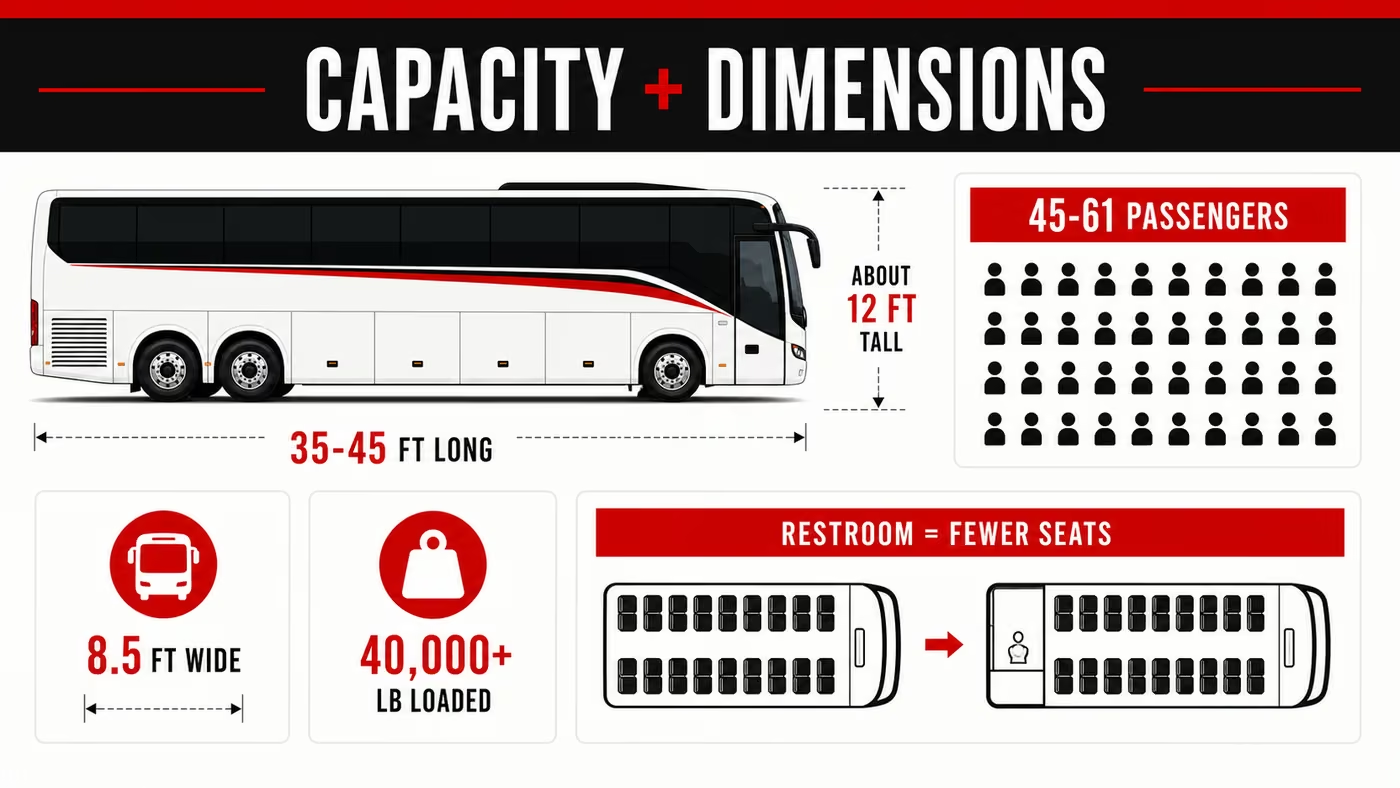
While Greyhound declined, the motorcoach itself evolved into a far more sophisticated vehicle. The 56-passenger motorcoach of 2026 has more in common with a Boeing 737 cabin than with the 1954 Scenicruiser. Air conditioning became standard in the 1970s.
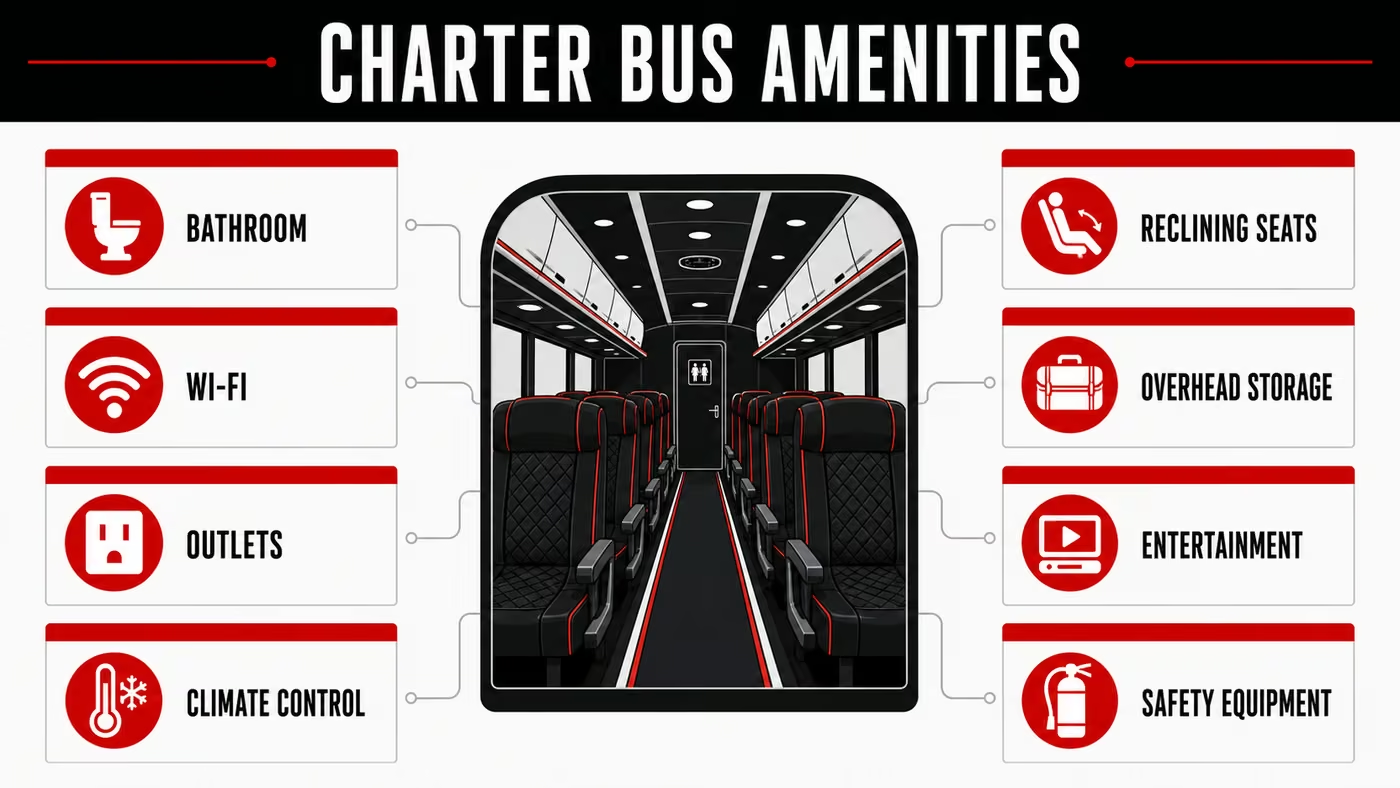
Bathrooms followed. Overhead bins replaced open parcel shelves. By the 1990s, the standard intercity coach offered reclining seats, individual reading lights, climate vents, and undercarriage luggage bays with capacities approaching 400 cubic feet.
The North American motorcoach industry through this period was dominated by a handful of manufacturers:
- Motor Coach Industries (MCI): The largest single manufacturer of motorcoaches in North America. The MCI MC-9, introduced in 1978 and sold through 1994, was the workhorse of American intercity travel for more than a decade. MCI's modern J-series and D-series coaches remain among the most-purchased motorcoaches by US tour and charter operators.
- Prevost: The Québec-based manufacturer became the dominant supplier of luxury entertainer coach shells—the chassis-and-body platforms that Liberty Coach, Marathon, Featherlite, Millennium, Emerald, LOKI, and other Prevost converter partners transform into the rolling palaces used by touring musicians.
- Van Hool: A Belgian manufacturer that entered the US market in 1987 through a partnership with ABC Companies. Van Hool coaches were popular with tour operators through the 2010s.
- Setra: The German luxury coach brand, owned by Daimler. Setra coaches were considered a gold standard of European-style touring buses in the US market.
- Volvo Bus / Nova Bus: Volvo's North American transit operations included Nova Bus assembly in Plattsburgh, New York, and Saint-Eustache, Québec for much of this period; in 2023 Nova Bus announced it would end U.S. production and close Plattsburgh by 2025, focusing North American production in Québec.
Engine technology evolved under regulatory pressure. The EPA's progressively tighter heavy-duty diesel emissions standards—2002, 2007, 2010—forced manufacturers to add exhaust gas recirculation (EGR), diesel particulate filters (DPF), and selective catalytic reduction (SCR) systems using diesel exhaust fluid (DEF). The result: a 2010-and-newer heavy-duty diesel engine is certified to a NOx limit of 0.20 g/bhp-hr, down from 10.7 g/bhp-hr for 1988 heavy-duty diesel truck engines—about a 98% reduction in the certification limit, before accounting for real-world duty-cycle differences.
The 2000s saw the rise of "curbside" low-cost intercity carriers. Megabus launched in the US in 2006 with $1 fares between Chicago and Midwestern cities, eventually expanding to a national network. BoltBus, a joint venture of Greyhound and Peter Pan, launched in 2008 in the Northeast Corridor.
Both carriers used double-deck coaches (notably the Van Hool TD925), free Wi-Fi, and aggressive online pricing to take young, urban riders away from Greyhound's traditional terminal-based model. BoltBus service was suspended in 2020 and later discontinued. After Coach USA's 2024 bankruptcy, the Megabus brand and route network were restructured, with some routes discontinued or transferred to partner operators rather than simply continuing as the same national network.
The 21st Century: Electric, Hydrogen, and Autonomous (2010s–2026)
The bus industry of 2026 looks fundamentally different from the bus industry of 2010. Three technology shifts—electrification, hydrogen fuel cells, and (slowly) automation—are remaking the vehicle on a scale not seen since the transition from horses to combustion engines.
Battery Electric Buses
The modern battery-electric bus era began in China. BYD (Build Your Dreams) produced its first K9 pure-electric bus in Changsha in 2010; 200 K9 buses entered operation in Shenzhen for the 2011 Summer Universiade. BYD scaled aggressively, and China became the dominant global electric-bus market.
The Chinese city of Shenzhen completed the full conversion of its municipal bus fleet—more than 16,000 buses—to electric power in 2017.
In the United States, Proterra became the most-watched domestic electric bus manufacturer. Founded in 2004 and headquartered initially in Golden, Colorado (later Burlingame, California), Proterra put its EcoRide BE35 battery-electric bus into Foothill Transit service in 2010; the Catalyst model followed later. The company filed for Chapter 11 bankruptcy in August 2023.
Its transit assets were acquired by Phoenix Motorcars; its battery business was acquired by Volvo.
BYD also established US manufacturing in Lancaster, California, in 2013, becoming a supplier of electric transit buses to American agencies including the Antelope Valley Transit Authority and Los Angeles Metro. AVTA committed to a 100% electric fleet in 2016, decommissioned its last diesel local bus in 2020, and announced a 100% zero-emission transit fleet in March 2022; that fleet included BYD buses, GreenPower vans, and MCI battery-electric commuter coaches. BYD's status as a U.S.
transit-bus supplier has been complicated primarily by Section 7613 of the FY2020 National Defense Authorization Act, codified at 49 U.S.C. § 5323(u), which limits the use of FTA funds for rolling stock from certain manufacturers tied to covered countries, including China.
Other US-relevant electric bus manufacturers include New Flyer (the Xcelsior CHARGE family), GILLIG (battery-electric variants of the Low Floor platform), Nova Bus (LFSe+), and the school bus electric pioneers Blue Bird, Thomas Built Buses (Jouley), and IC Bus (chargE).
Hydrogen Fuel Cell Buses
Hydrogen fuel cell electric buses (FCEBs) offer the range and refueling speed of diesel with zero tailpipe emissions. Real-world deployments have grown through the 2020s:
- Toyota Sora: Tokyo's hydrogen fuel cell transit bus, introduced ahead of the 2020 (held 2021) Olympics.
- New Flyer Xcelsior CHARGE H2: Currently operating in Champaign-Urbana, Illinois (the CUMTD); the Orange County Transportation Authority in California; and several other US agencies.
- SARTA (Stark Area Regional Transit Authority) in Canton, Ohio, runs one of the longest-tenured American hydrogen bus deployments, dating to 2017.
Hydrogen's challenges remain familiar: refueling infrastructure is sparse, green hydrogen is expensive, and gray hydrogen (made from natural gas) undermines the carbon case. But for long-route applications where battery-electric buses struggle—mountainous terrain, extreme cold, long intercity hauls—hydrogen remains a serious contender.
Autonomous Buses
Autonomous bus pilots multiplied through the late 2010s and into the 2020s. Local Motors launched the Olli shuttle in 2016—a small 3D-printed autonomous people-mover. Local Motors closed in January 2022.
Navya and EasyMile, both French companies, deployed autonomous shuttles in dozens of US pilot programs, including downtown Las Vegas, Texas A&M, and the University of Michigan's Mcity. Optimus Ride ran an autonomous shuttle program at the Brooklyn Navy Yard beginning in 2019; Magna acquired Optimus Ride's technology, intellectual property, assets, and much of its engineering team in January 2022.
As of 2026, autonomous bus deployments in the United States remain overwhelmingly limited, restricted, and geofenced—more pilot program than ordinary bus service. Most operating automated shuttles run at low speeds, often with safety attendants aboard. The vehicles work in constrained conditions; the regulatory, liability, labor, and business-model frameworks have not caught up.
The autonomous bus future is closer than it was in 2015, and farther than the more optimistic 2018-era predictions suggested.
Industry Shifts of the 2020s
The 2020s reshaped the motorcoach and intercity bus industry in ways the early decade did not see coming:
- COVID-19 (2020–2022): Public-transit ridership fell by as much as 80% in April 2020, and intercity, charter, and school-bus operators also saw severe service disruptions and traffic losses. Recovery has been uneven—business travel by coach remains below 2019 levels, while leisure and group travel rebounded more strongly by 2023.
- FlixMobility acquires Greyhound (2021): The German intercity bus operator FlixBus (parent: FlixMobility, now Flix SE) acquired Greyhound Lines from FirstGroup in October 2021 for an enterprise value of about $46 million; FirstGroup said total cash proceeds were about $172 million, with part of that used to pay down Greyhound liabilities and lease obligations. The iconic running-greyhound logo continues under German ownership.
- Van Hool bankruptcy and asset sales (2024): The Belgian manufacturer Van Hool was declared bankrupt in April 2024. VDL acquired parts of the bus and coach business, including the motorcoach division and North Macedonia facility, while GRW acquired the Industrial Vehicles unit.
- Setra distribution changes in North America: Daimler ended MCI's U.S. and Canadian Setra distribution rights in 2018, shifted sales to REV Coach, and later formed Daimler Coaches North America to handle Setra sales, parts, and service directly.
- School bus driver shortage: The post-COVID period exposed a chronic shortage of school bus drivers across the United States, leading to consolidated routes, longer rides, and in many districts, temporary service suspensions for some neighborhoods.
A Regional View: How Bus History Unfolded Around the World
The history of buses is not one story—it is several, running in parallel across continents.
United Kingdom
From Shillibeer's 1829 London omnibus through the B-type, the K-type, the Routemaster, and the modern New Routemaster, British bus history runs straight through London. The AEC Routemaster, introduced in 1956 and produced until 1968, became the global icon of the British double-decker: red, open rear platform, conductor on board. Routemasters remained in scheduled London service until 2005.
The New Routemaster, designed by Heatherwick Studio and built by Wrightbus, entered service in 2012 under London Mayor Boris Johnson—the "Boris bus." Production ended in 2018 after 1,000 units. London buses began going zero-emission in significant numbers from 2020 onward; TfL is committed to a fully zero-emission bus fleet by 2034.
France
Pascal in 1662, Baudry in 1826, and through the 19th and 20th centuries a dense French manufacturing base—Renault, Berliet, Saviem, and today Renault Trucks (now Volvo Group), Iveco Bus (formerly Irisbus), and Heuliez Bus. Paris operates one of the largest bus systems in Europe through RATP and is among the European leaders in electric bus adoption.
Germany
Benz in Siegerland, 1895. Through the 20th century, Germany became home to Mercedes-Benz Bus, MAN, Setra (acquired by Daimler in 1995), and Neoplan (acquired by MAN in 2001). Mercedes-Benz Setra and MAN are today dominant European luxury coach brands.
Germany's intercity bus deregulation in 2013 opened the door for FlixBus, founded in Munich in 2011 and launched in 2013, which has grown into the dominant intercity bus operator in Europe and (since the 2021 Greyhound acquisition) the United States.
United States
The American story runs from Brower's 1827 Broadway omnibus through Yellow Coach Manufacturing, Greyhound, MCI, Wayne Works' School Car, Blue Bird, and the modern manufacturers—MCI, Prevost, New Flyer, GILLIG, Nova Bus, Blue Bird, Thomas Built, IC Bus. The United States operates the world's largest school bus fleet, with more than 480,000 school buses carrying more than 25 million children daily, according to American School Bus Council estimates cited by Smithsonian Magazine.
China
The largest bus manufacturing country in the world. Yutong, founded in 1963 and headquartered in Zhengzhou, is the single largest bus manufacturer on Earth by units produced, with annual sales exceeding 40,000 buses in 2024. BYD, founded in 1995 as a battery company, transformed itself into the world's most prolific electric bus manufacturer.
China has been the global leader in deploying battery-electric municipal transit buses since the mid-2010s.
Brazil
The world's leading bus body builder is Marcopolo, founded in 1949 in Caxias do Sul. Marcopolo bodies are mounted on chassis from Mercedes-Benz, Scania, Volvo, and others and sold across South America, Africa, and parts of Asia.
India
Tata Motors and Ashok Leyland dominate the Indian bus market. India operates one of the world's largest bus networks by passenger-kilometers, and Mumbai's BEST bus system carries more than two million passengers per day.
Firsts in Bus History: A Comparison Table
The single most-asked questions about bus history are "first" questions: first omnibus, first school bus, first electric, first double-decker. Here they are, in one place.
| Milestone | Year | Location | Person / Manufacturer | Key Detail |
|---|---|---|---|---|
| First scheduled public transit | 1662 | Paris, France | Blaise Pascal | Five routes; 5 sols per ride; restricted to elite passengers |
| First omnibus (modern era) | 1826 | Nantes, France | Stanislas Baudry | Origin of the word "bus" |
| First London omnibus | 1829 | London, UK | George Shillibeer | Paddington to Bank, 3-horse, 22 passengers |
| First steam bus service | 1833 | London, UK | Walter Hancock | Enterprise; later suppressed by hostile tolls and regulation |
| First electric trolleybus | 1882 | Halensee, Berlin | Werner von Siemens | Demonstrated as the Elektromote |
| First documented purpose-built school-transport vehicle | 1892 | Ohio / Wayne Works of Indiana | Wayne Works | Horse-drawn "School Car" for rural students |
| First motor bus service | 1895 | Siegerland, Germany | Carl Benz / Netphener Omnibus-Gesellschaft | 15 km route, 8 passengers |
| First reliable mass-produced motor bus | 1910 | London, UK | LGOC B-type | Defined the early motor-bus revolution in London |
| Greyhound predecessor begins | 1914 | Hibbing, Minnesota | Carl Eric Wickman | Seven-passenger car carrying miners between Hibbing and Alice |
| First Blue Bird school bus | 1927 | Fort Valley, Georgia | Albert L. Luce Sr. | Oldest surviving example at Henry Ford Museum |
| Yellow school bus standard adopted | 1939 | New York City, New York | Frank W. Cyr | 44 national standards including the yellow color |
| First Volkswagen Type 2 (Microbus) | 1950 | Wolfsburg, Germany | Volkswagen | Counterculture icon by 1960s |
| First Greyhound Scenicruiser | 1954 | USA | GM / Greyhound | Split-level 43-passenger coach |
| First articulated bus (modern) | 1950s | Germany | various, MAN/Büssing | "Bendy bus" for high-capacity routes |
| Early U.S. diesel-electric hybrid bus deployment | 1998 | New York City | Orion VI / BAE HybriDrive pilot | 10-bus NYCT test fleet; King County's 2003 New Flyer order was a major fleet purchase, not the first |
| Early mass-production battery-electric bus | 2010 | Changsha/Shenzhen, China | BYD K9 | First K9 produced in 2010; 200 operated in Shenzhen for the 2011 Universiade |
| First commercial autonomous shuttle (US) | 2016 | National Harbor, Maryland | Local Motors Olli | Geofenced, low-speed, attendant-supervised |
| First Olympic hydrogen bus fleet | 2021 | Tokyo, Japan | Toyota Sora | Deployed for the delayed 2020 Olympics |
Frequently Asked Questions About the History of Buses
When were buses invented?
The first scheduled public transit service was launched in Paris on March 18, 1662, by French mathematician Blaise Pascal. The first motor bus service was launched in Siegerland, Germany, in 1895 using vehicles built by Carl Benz.
Who invented the bus?
Three people share credit depending on the definition. Blaise Pascal invented scheduled public transit (1662). Stanislas Baudry created the modern omnibus model in Nantes in 1826 and helped popularize the name.
Carl Benz built the first motor bus (1895, Siegerland).
When was the first bus made in America?
The first American omnibus service was launched by Abraham Brower in New York City in 1827, running along Broadway in a converted stagecoach. The first scheduled American motor bus services launched in the 1900s, with intercity networks expanding rapidly through the 1920s as Greyhound and its predecessors took shape.
When were school buses invented?
The best-documented early purpose-built school-transport vehicle was Wayne Works' horse-drawn "School Car," built in 1892 for an Ohio school district. The first motorized school buses appeared in the 1910s and '20s, with Blue Bird's 1927 Fort Valley, Georgia model widely regarded as the oldest surviving example.
Who invented the school bus?
The best-documented horse-drawn school-transport vehicle was built by Wayne Works in 1892. The first motorized purpose-built school bus is generally credited to Albert L. Luce Sr., who founded Blue Bird in Fort Valley, Georgia, in 1927.
Why are school buses yellow?
The color was selected in April 1939 at a seven-day conference convened by Columbia University education professor Frank W. Cyr at Teachers College, Columbia University, in New York City. The conference standardized 44 school bus specifications and chose "National School Bus Chrome" for its visibility, its strong contrast with black lettering, and its distinctiveness against typical road backgrounds.
Is America the only country with yellow school buses?
No. Canada and parts of Mexico use similar yellow-and-black school bus standards. A handful of other countries have adopted yellow for school transport.
But the iconic American yellow school bus, with its black hood lettering and federally mandated flashing red lights and stop arm, is a uniquely North American phenomenon. Most countries do not operate dedicated school-bus fleets; students take public transit, walk, or are driven privately.
When were double-decker buses invented?
Open-top double-deck horse-drawn omnibuses appeared in London in the 1840s and '50s. Motorized double-deck buses were operating in London by the early 1900s; the 1910 London General Omnibus Company B-type was the first reliable, mass-produced motor bus and the defining early motorized double-decker. The iconic AEC Routemaster, the global symbol of the British double-decker, entered service in 1956.
What was the first motor bus?
The first motor bus service was the Netphener Omnibus-Gesellschaft, launched in Siegerland, Germany, on March 18, 1895, using Benz Omnibus vehicles built by Carl Benz. The route ran 15 kilometers between Siegen, Netphen, and Deuz.
Where did the word "bus" come from?
It is a shortened form of "omnibus," Latin for "for all." French entrepreneur Stanislas Baudry began calling his Nantes shuttle service voitures omnibus in the 1820s. The word "omnibus" entered English (via French) shortly afterward and was shortened to "bus" by the mid-19th century.
What was the first electric bus?
The first electric trolleybus (overhead-wire-powered) was Werner von Siemens's Elektromote, demonstrated in Halensee, Berlin, in 1882. An early mass-production battery-electric bus was the BYD K9: the first K9 was produced in Changsha in 2010, and 200 entered operation in Shenzhen for the 2011 Summer Universiade.
Who founded Greyhound?
Carl Eric Wickman, a Swedish immigrant, started carrying miners between Hibbing, Minnesota, and nearby Alice in 1914 using a seven-passenger car. His operation grew into the regional bus companies that eventually became Greyhound Lines. FlixMobility acquired Greyhound in October 2021.
When were MCI and Prevost founded?
Prevost was founded in 1924 in Sainte-Claire, Québec, by cabinetmaker Eugène Prevost. Motor Coach Industries (MCI) was founded in 1933 in Winnipeg, Manitoba, by Harry Zoltok as Fort Garry Motor Body and Paint Works, renamed MCI in 1941.
How many people ride buses worldwide each year?
Estimates vary, but global bus and coach passenger journeys are measured in the tens of billions annually. The American Public Transportation Association reported that U.S. bus ridership rose to about 3.8 billion trips in 2024.
China's public buses registered 37.81 billion trips in the first 11 months of 2023.
What is the largest bus ever built?
The Volvo Gran Artic 300, launched in 2016 for service in Brazil and other South American markets, is a bi-articulated bus measuring 30 meters (98 feet) in length and capable of carrying up to 300 passengers. It remains one of the largest buses built for regular service.
Sources and Further Reading
This guide synthesizes primary and secondary historical sources. Consult the following for deeper research:
- Britannica: Pascal and the 1662 debut of the world's first public transit system
- Library of Congress: Stanislas Baudry, Nantes, and the Omnès/omnibus legend
- Science Museum Group: George Shillibeer's 1829 London omnibus
- London Transport Museum: Horse-bus history, the B-type, and the motor-bus revolution
- Imperial War Museums: B43 "Ole Bill" and First World War B-type service
- Smithsonian Magazine: School bus history and the 1892 Wayne Works School Car
- Teachers College, Columbia University: Frank W. Cyr and the 1939 yellow school bus standards conference
- The Henry Ford Museum: 1927 Blue Bird school bus and Albert L. Luce Sr.
- Greyhound: Carl Eric Wickman and Greyhound company history
- APTA: Annual public transit ridership statistics
- Federal Transit Administration: Federal procurement restrictions affecting covered rolling-stock manufacturers
- Reuters, Volvo Group, BYD, AVTA, MCI, Prevost, and other manufacturer/operator sources: Modern industry events and fleet details
Why This History Still Matters
From Pascal's 1662 carriages through Baudry's Nantes shuttle, from Hancock's banned steam buses to the B-types at Ypres, from Frank Cyr's 1939 New York City standards conference to the BYD K9 rolling through Shenzhen, the bus has been continuously reinvented for more than 360 years. It is the oldest form of scheduled mass transit on Earth, the most common form of public transportation in the world today, and a vehicle that quietly carries tens of billions of passenger trips per year.
At Party Bus Chesapeake, we operate motorcoaches whose corporate lineage runs straight back to that history—MCI buses descended from Harry Zoltok's 1933 Winnipeg paint shop, Prevost coaches descended from a Québec cabinetmaker in 1924. Every 56-passenger motorcoach in our fleet, every 14-passenger Sprinter limo we send to a wedding, every 15- to 50-passenger party bus we deploy for a bachelorette night carries some piece of this 360-year story.
If you are planning a trip and want to ride a coach descended directly from this lineage, call us any time at 757-755-8162. Our reservation team is available 24/7/365, and our online quote tool returns instant pricing in under 30 seconds.