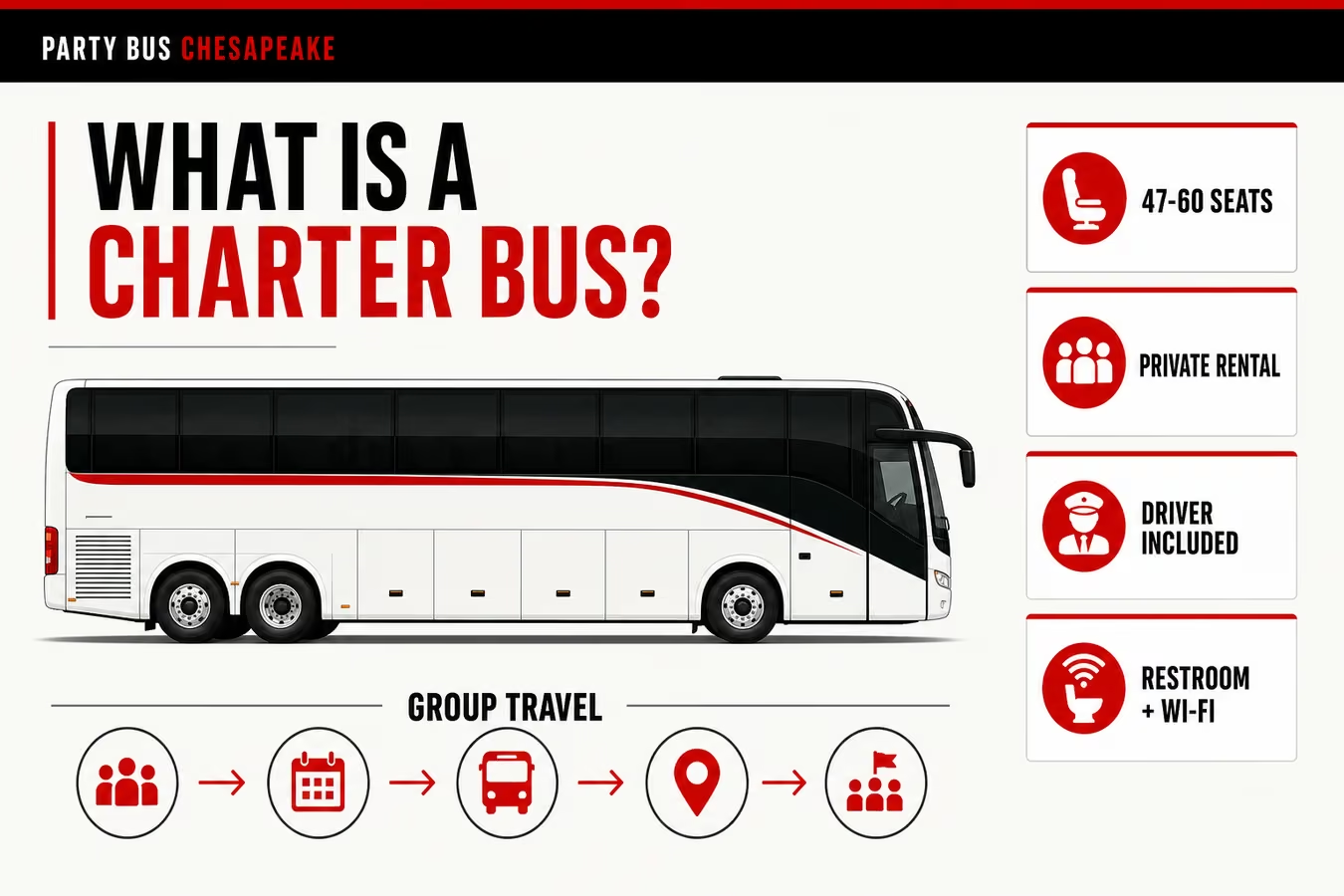
A charter bus is a large, privately-rented motor coach designed for long-distance group travel. Most charter buses seat 47–60 passengers, run on diesel or, increasingly, electric powertrains, and come with reclining seats, climate control, on-board restrooms, luggage bays, and Wi-Fi. The vehicle is rented exclusively for a single group's trip—unlike public transit or shuttle buses, which serve multiple unrelated passengers.
Major manufacturers include Prevost, MCI, Van Hool, and Setra.
An aggregator can tell you what a charter bus is. An operator can tell you what one's actually like to book, ride, and drive. At Party Bus Chesapeake, we've been running group trips in and around Chesapeake, Virginia for over 15 years—wedding shuttles to Norfolk and Virginia Beach, school field trips to Colonial Williamsburg, corporate retreats up to Richmond, sports team travel down the I-64 corridor, and church group outings to the Outer Banks.
This guide walks you through what a charter bus actually is—capacity, amenities, manufacturers, how it compares to other vehicles, what it costs, and how rental works—and links you down to deeper guides on each of those topics. If you're planning a 20+ person trip and weighing your options, you're in the right place. Call 757-755-8162 any time, or use our 30-second quote tool to see live pricing and availability.
Charter bus, defined—and what "charter" actually means
The word "charter" simply means rented exclusively for one group's use. When you charter a bus, you're booking the entire vehicle—driver included—for your group only, on your schedule, between your chosen stops. Public transit and scheduled intercity coaches (Greyhound, FlixBus) work differently: they run fixed routes on fixed schedules and sell individual seats to unrelated passengers.
A charter bus does neither. It runs your route on your schedule for your group.
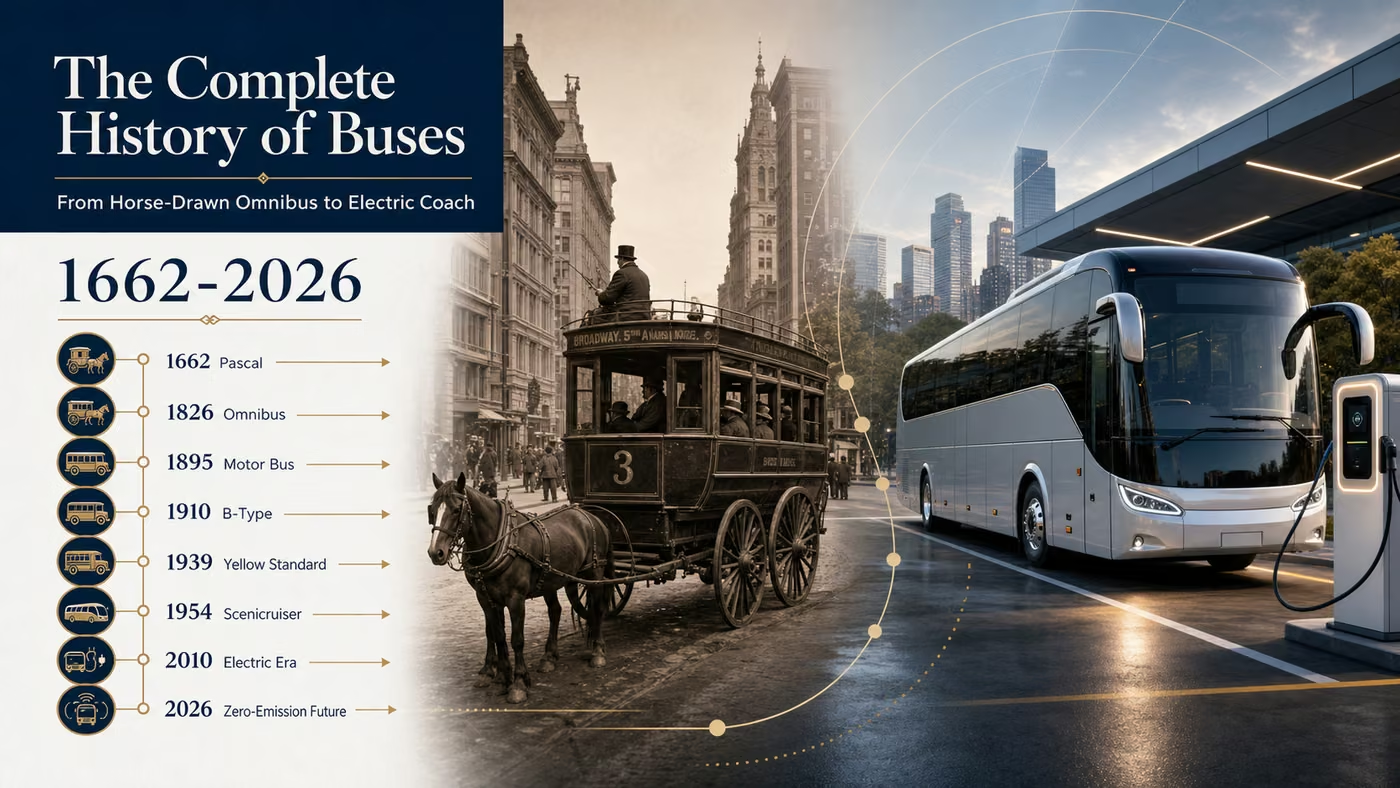
The terminology around these vehicles is genuinely confusing. "Coach bus," "motorcoach," and "charter bus" are largely synonymous in American usage—all three describe the same general class of long-distance group vehicle. The Wikipedia entry on Coach (bus) traces the term back to horse-drawn coaches built for inter-city travel in 18th-century Europe; the modern motorcoach inherits the layout and purpose.
What a charter bus looks like (exterior, interior, key features)
Exterior. A standard charter bus is a single-deck rigid vehicle—no articulation, no second story—running 35 to 45 feet long. You'll see a single entrance door near the front, large tinted windows running the length of the cabin, and luggage bays built into the undercarriage between the wheels.
The roofline is high to accommodate stand-up interior space and overhead racks. Most US fleets run in white or neutral livery; entertainer coaches and luxury tiers sometimes wrap in custom paint.
Interior. Step inside and you'll find reclining cloth or leather seats in a 2-2 configuration—two seats on each side of a center aisle—with overhead racks running the length of the cabin for small bags, jackets, and personal items. Seats typically recline 4 to 5 inches and include footrests on most modern fleets.
USB and AC outlets are standard at most seats. Climate control runs the full length of the cabin with overhead vents. The restroom sits at the rear of the bus, set off by a small door.
Many fleets include Wi-Fi and overhead monitors for video; entertainer coaches and luxury tiers add lounge seating, galleys, and dedicated power systems.
For the full walkthrough—seat pitch, recline angles, restroom layout, where the driver sits, what the dashboard looks like—see our inside-a-charter-bus guide.
Charter bus capacity and dimensions
Capacity ranges from 45 to 61 passengers depending on the platform, configuration, and whether the bus includes a restroom (which costs about 4 seats of floor space). The most common US charter platform—the MCI J4500 and Prevost H3-45—seats 56 with a restroom or up to 60 without.
Dimensions are largely standardized by federal and state road regulations. A typical charter bus runs 35 to 45 feet in length, about 8.5 feet wide, and roughly 12 feet tall. Empty curb weight is 25,000 pounds and up.
Fueled and fully loaded with 56 passengers and luggage, you're often pushing 40,000+ pounds—which is why charter buses need designated loading zones and can't access every parking lot.
At Party Bus Chesapeake, we operate a 40–56 passenger charter bus on the higher end of the standard range—the right pick for full school grade levels, large wedding parties, or corporate conference shuttles. For deeper detail on seat counts across platforms, see our seating capacity guide; for length, width, height, and weight specifics, see our charter bus dimensions guide.
Charter bus amenities (what's actually included)
Modern charter buses come with most of the amenities you'd expect from a hotel room with wheels. Here's what's standard on current-fleet vehicles, with link-downs for the questions we get asked most:
- Bathrooms. Yes—most full-size charter buses have an on-board restroom at the rear, set off by a small door. See do charter buses have bathrooms for how they work, who maintains them, and when they're available.
- Wi-Fi. Increasingly standard across modern fleets. Coverage varies by route and cellular signal strength. See do charter buses have Wi-Fi.
- Outlets. USB and AC power at most seats on modern fleets. See do charter buses have outlets.
- Climate control. Full HVAC running the length of the cabin, driver-controlled from the front.
- Reclining seats. Typically 4–5 inch recline, with most platforms including footrests and adjustable headrests.
- Overhead storage. Open racks above the seats for personal items; large luggage bays underneath the cabin for suitcases, sports equipment, instruments, and event gear.
- Entertainment. Overhead monitors, PA system, and on newer fleets, streaming options and USB input.
- Safety equipment. Three-point seatbelts (standard on modern motorcoaches), multiple emergency exits, fire suppression, and onboard first-aid.
For the comprehensive list—including amenities you might not expect, like reading lights, individual climate vents, and galley options on luxury tiers—see our charter bus amenities guide.
Who makes charter buses? (Manufacturer overview)
The US charter market is dominated by a handful of manufacturers, most with overlapping platforms across the mid and premium tiers:
- Prevost (part of the Volvo Group) builds the H3-45, X3-45, and the H3-45 VIP entertainer coach. Premium tier—the H3-45 is the most common platform on US luxury charter routes and entertainer tours, with a tall roofline, generous luggage capacity, and a reputation for ride quality. See our Prevost H3-45 breakdown.
- MCI (Motor Coach Industries) builds the J4500, J3500, D45 CRT LE Charter, and the D-Series. MCI holds the largest share of the US charter operator market; the J4500 is the workhorse of the industry. See our MCI J4500 breakdown.
- Van Hool builds the CX45, CX35, and T-Series. European-origin and common in the US mid-tier charter market, with a strong reputation for fuel efficiency and interior layout flexibility.
- Setra (part of Daimler) builds the TopClass S 517 and S 515 HD. Premium European tier—less common in standard US charter but a regular sight on luxury and entertainer routes.
- Temsa builds the TS35, TS45, and HD12. A mid-range option that's gained share in the US market over the past decade.
- Modern electric variants. Proterra, BYD K11, and the New Flyer Xcelsior CHARGE are the leading electric platforms, mostly serving fixed-route and shuttle applications today but increasingly appearing on shorter charter runs.
For the full breakdown of each manufacturer's platform lineup, model histories, and where you'll see each one in the wild, see our charter bus manufacturers overview.
How a charter bus differs from other vehicles (the master comparison)
If you've started shopping, you've probably noticed the category is full of overlapping names—charter bus, motorcoach, coach bus, shuttle bus, party bus, minibus, Sprinter van. Here's how they actually differ on the things that matter to a group planner: capacity, restroom, long-distance comfort, and price. Use this as your decision table; the link-downs go to the deeper guide on each vehicle.
| Vehicle type | Capacity | Restroom | Long-distance comfort | Best for | Typical hourly rate | Related page |
|---|---|---|---|---|---|---|
| Charter bus | 45–61 | Yes | High | Long-distance group travel, multi-day tours, large weddings, school grade-level trips | $162–$348+/hr | 40–56 passenger charter bus |
| Motorcoach | 45–61 | Yes | High | US synonym for charter bus; same full-size coach class | $162–$348+/hr | Full-size coach rental |
| School bus | Up to 72 | No | Low | Local school routes and short field trips with bench seating | Varies by district | School event transportation |
| Shuttle bus | 14–30 | Rarely | Medium | Airport transfers, hotel loops, and short event routes | $100–$200/hr | Group transportation services |
| Party bus | 15–50 | Sometimes | Medium | Bachelorette nights, birthdays, prom, brewery tours, and celebration trips | $150–$300/hr | Party bus guide |
| Minibus | 15–35 | No | Medium | Mid-size groups, in-town shuttles, executive runs, and local transfers | $110–$220/hr | 15–35 passenger minibus |
| Sprinter van | Up to 14 | No | Medium-high | Executive transfers, small VIP groups, and airport runs | $95–$175/hr | Sprinter van rental |
| Public bus | Varies | No | Low | Fixed-route urban transit | Per-ride fare | Not a private rental |
| Scheduled intercity coach | 50–55 | Yes | Medium | Individual intercity travel on a fixed schedule | Per-ticket | Not a private rental |
For the broader taxonomy—including double-deckers, articulated buses, and specialty platforms—see our complete types of buses guide.
When to choose a charter bus—common use cases
Here's where the 45–56 passenger charter bus actually shines, with examples drawn from the trips we run most often in and around Chesapeake, Virginia.
Wedding shuttles. Hampton Roads weddings often span multiple venues—ceremony at a church or estate, photos at Norfolk Botanical Garden or the Chesapeake Arboretum (624 Oak Grove Rd), reception at a venue like The Founders Inn in Virginia Beach. A single charter bus loops guests across the entire timeline so nobody navigates the Hampton Roads Bridge-Tunnel solo after cocktails.
See our wedding party bus rentals.
School field trips. Chesapeake-area schools regularly book charter buses for full-grade trips to Colonial Williamsburg, the Virginia Living Museum in Newport News, the Virginia Aquarium & Marine Science Center in Virginia Beach, and the Smithsonian museums up in DC. The undercarriage bays handle coolers and sack lunches; the climate-controlled cabin handles 56 students far better than a yellow school bus on a 3-hour ride.
See our school event bus rental.
Sports team travel. Youth and high-school teams across Chesapeake, Suffolk, and the Western Branch corridor use charter buses for tournament travel up to Richmond, down to the Outer Banks, and over to Williamsburg. Undercarriage bays hold equipment bags; reclining seats let players rest between games.
See our sporting event party bus.
Corporate retreats and employee shuttles. The major employers around Chesapeake—the shipyards, the Port of Virginia, the medical campuses—regularly run employee shuttles and offsite retreats. A charter bus with WiFi and outlets keeps your team productive on the run to Williamsburg or Richmond.
See corporate event transportation.
Church group outings. Chesapeake's large church congregations regularly charter buses for retreat weekends, mission trips, and group outings—everything from Sight & Sound Theatre in Lancaster, PA to revivals in the Carolinas.
Senior group and retiree trips. Active retiree groups in Greenbrier and Western Branch book day trips to Colonial Williamsburg, fall foliage runs up the Skyline Drive, and casino runs to Hollywood Casino in Charles Town. Onboard restrooms and reclining seats make the distance comfortable.
Military reunions and unit travel. With Naval Station Norfolk, Joint Expeditionary Base Little Creek-Fort Story, and Naval Medical Center Portsmouth all within the Hampton Roads region, military unit travel and reunion logistics are a regular ask. We've shuttled unit reunions across multiple venues over long weekends.
Music tours and film productions. Entertainer coaches—Prevost H3-45 VIP variants and similar platforms—serve touring bands, theatre companies, and film productions. These aren't standard charter buses; they're built around bunks, lounges, and galleys.
Multi-day group tours. Charter buses are the right pick for any trip that runs 2+ days with the same group. Undercarriage luggage capacity, on-board restroom, and overnight-friendly seating make the difference.
Concert and event transportation. Groups heading to Veterans United Home Loans Amphitheater in Virginia Beach, Chartway Arena in Norfolk, or stadium shows up in DC consistently choose a charter bus over the parking-and-rideshare scramble. See our concert party bus.
How much does a charter bus cost?
At a high level: charter bus pricing in the US runs roughly $162–$348+ per hour or $1,331–$2,841+ per day, depending on the trip. The major pricing drivers are distance (total miles), trip duration (single-day vs multi-day), peak season vs off-season, vehicle tier (standard vs luxury vs entertainer), and which amenities are included.
At Party Bus Chesapeake, our quotes are all-inclusive—the price you see is the price you pay—and they take about 30 seconds to generate through our online quote tool, with no account required. For the deep breakdown of what drives charter bus pricing in the Chesapeake market specifically, see our Chesapeake pricing page.
How charter bus rental works (the process)
Renting a charter bus is simpler than most people expect. Here's the four-step process we run for every group:
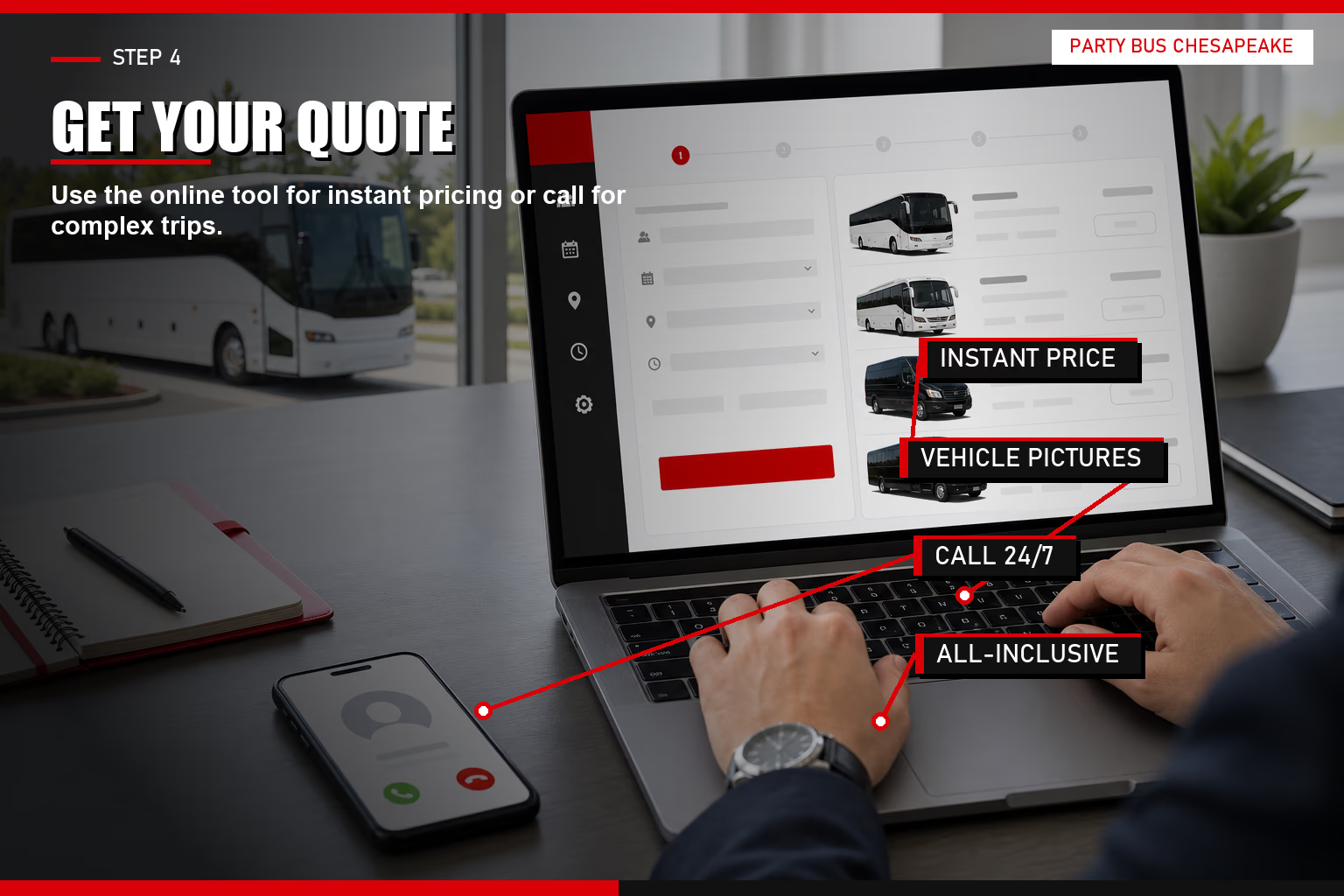
Step 1: Request a quote. Use our 30-second online quote tool or call 757-755-8162. You'll need a rough headcount, your trip dates, and your pickup and dropoff cities.
Live pricing and vehicle availability come back immediately. No account, no commitment.
Step 2: Lock in the date with a deposit. Once you've reviewed the quote and chosen your vehicle, a deposit holds the date. The closer you book to a peak weekend (prom, graduation, major sports tournaments, summer wedding season), the more important early booking becomes—Hampton Roads fleets get thin in May and June.
Step 3: Provide the itinerary. Detailed pickup time, all stops with addresses, dropoff time, and any special instructions (ADA accommodation, oversized luggage, multi-pickup loops). Drivers need this in advance for hours-of-service planning—the federal regs cap driving time, and a clean itinerary keeps everything in compliance.
Step 4: Day-of pickup with assigned driver. Your assigned driver arrives at the pickup point ahead of schedule. From there, the trip runs on your itinerary.
For the deeper walkthrough—what to ask during the quote process, how to handle multi-stop itineraries, what to do if your plans change—see our how-to-rent guide.
Tipping the charter bus driver
Most competitor sites skip this question, but it comes up on nearly every booking call we take. The industry norm is 10–20% of the total trip cost, with a $20–$50 minimum for short single-trip runs and $100+ for multi-day trips where the driver is with your group the entire time.
Tipping is at customer discretion—it's not built into the quote and it's not a hidden line item. Some groups hand a tip directly at the end of the trip; others build it into a final payment with the operator. For multi-day trips that require a two-driver crew under federal hours-of-service rules, the tip should reflect both drivers, not just the one you spent the most time with.
FAQ
What is a charter bus and how is it different from a regular bus?
A charter bus is rented exclusively for a single group's use, on the group's schedule and route. A "regular bus"—whether public transit, a school bus, or a scheduled intercity coach like Greyhound—runs a fixed route on a fixed schedule and sells seats individually to unrelated passengers. The vehicle class is similar; the rental model is what makes it "charter."
How many people fit on a charter bus?
Standard US charter buses seat 45–61 passengers depending on platform and configuration. With an onboard restroom, capacity typically lands at 47–56; without a restroom, you can push toward 60. At Party Bus Chesapeake, our 40–56 passenger charter bus covers the high end of the standard range.
How much does it cost to rent a charter bus?
Roughly $162–$348+ per hour or $1,331–$2,841+ per day, depending on distance, duration, season, and vehicle tier. Use our 30-second quote tool for live pricing on your specific trip.
Do charter buses have bathrooms?
Yes—most full-size charter buses have an on-board restroom at the rear of the cabin. See our full guide.
What's the longest distance a charter bus can travel in one day?
Federal hours-of-service rules cap a single driver at 10 hours of driving within a 15-hour duty period, which works out to roughly 500–600 highway miles in practice. For trips beyond that, you'll need a two-driver crew, which extends range significantly but adds to the quote.
Do I need a special license to ride a charter bus?
No—passengers don't need any license or special documentation. The driver holds a Commercial Driver's License with a passenger endorsement; passengers just need to be on the manifest.
How much should I tip my charter bus driver?
10–20% of the trip cost is the industry norm. $20–$50 minimum on short runs; $100+ on multi-day trips. For two-driver crews, the tip should account for both.
Are charter buses safe?
Modern charter buses are among the safest forms of group ground transportation. They include three-point seatbelts, multiple emergency exits, fire suppression, and onboard first-aid. Operators are regulated by the Federal Motor Carrier Safety Administration and subject to hours-of-service, vehicle inspection, and insurance requirements.
Conclusion
A charter bus is, at its simplest, a 45–61 passenger motorcoach rented privately for one group's trip—your itinerary, your timing, your stops, your group only. The value sits in three things: private group rental (no fixed schedule, no shared seats), comfortable long-distance travel (reclining seats, restroom, climate, WiFi, outlets), and all-inclusive transparent pricing from regulated operators.
If you're planning a group trip in or around Chesapeake, Virginia and considering a charter bus, Party Bus Chesapeake operates a 40–56 passenger charter bus across our service area, with all-inclusive pricing and 30-second online quotes. Check our service areas to see where we run, or call 757-755-8162 any time—our reservation team is on 24/7/365.